
Residential mini-split line set length typically runs to somewhere between 50 and 100 ft (15–30 m) in total, with a tighter limit on the height difference between the two units. That range is close to useless on its own, because the figure varies by several tens of feet between models and your installation manual is the only authority for yours.
What is worth knowing is the part every guide skips: there are four separate limits, not one, and they all exist for the same underlying reason.
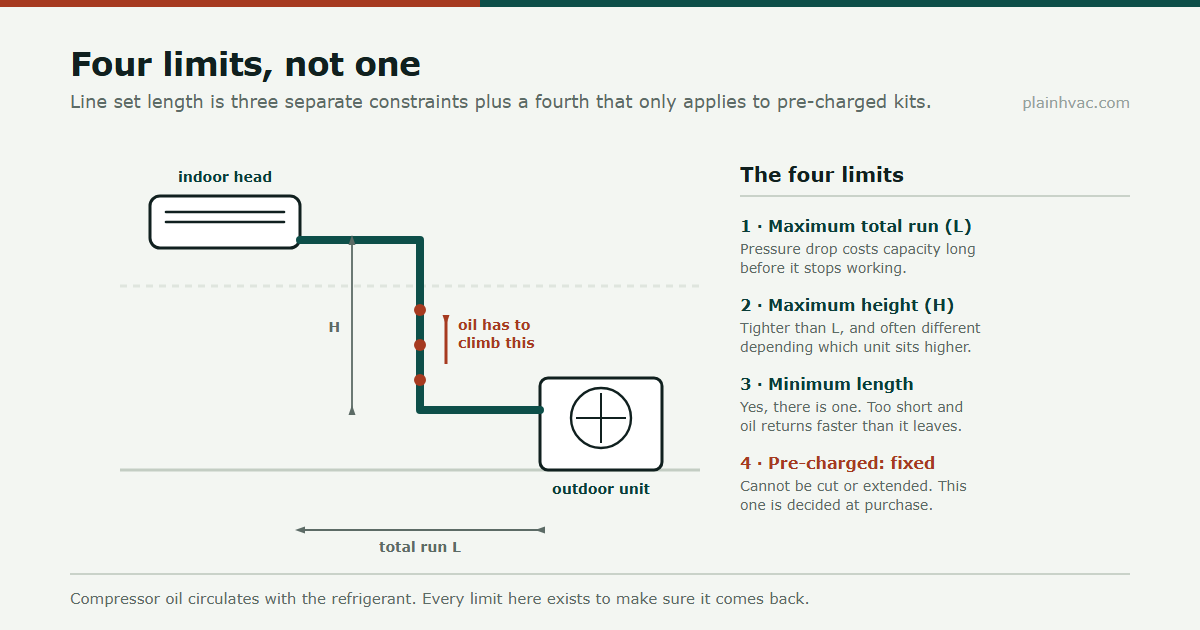
The reason all four limits exist
A compressor needs lubricating oil, and the refrigerant it runs on is a regulated substance handled under schemes like EPA Section 608. In a sealed refrigerant system there is no separate oil circuit — the oil leaves the compressor mixed with the refrigerant, and the refrigerant has to carry it all the way round the loop and back.
Refrigerant vapour moving fast enough drags the oil along with it. Moving too slowly, it does not, and the oil pools at the low points and in the vertical risers instead of returning. The compressor then runs progressively drier, which is the failure nobody attributes to the line set because it happens years later.
Every length limit in your manual is really a statement about oil return and pressure drop. That is why exceeding them does not produce an immediate fault — it produces a shorter life.
Limit 1: maximum total run
The longest permitted distance from one unit to the other, counting every bend and the vertical section along the real path.
Long before you reach the maximum, you lose capacity. Pressure drop along the line means the refrigerant arrives at a less useful state than it left, and manufacturers publish derate factors for exactly this. A system near its maximum can deliver noticeably less than its nameplate rating.
Two practical consequences. Bends count — each one adds an equivalent length that most manuals quantify. And you measure the route, not the straight line, following the wall, round the corner, down to the ground.
Limit 2: maximum height difference
Almost always tighter than the total run, and this is the one people breach without realising.
Many manuals give two different figures depending on which unit is higher. That asymmetry is not arbitrary: when the outdoor unit sits below the indoor head, the refrigerant has to lift the oil back up against gravity, so manuals usually allow a smaller rise than drop.
If your outdoor unit is at ground level and the head is on a second floor, this is the limit to check first, before the total length.
Limit 3: minimum length
Rarely mentioned and genuinely real. Manuals commonly specify a minimum of around 10 ft (3 m).
Two things go wrong on a very short run. The factory charge is calculated for a nominal length, so a much shorter line leaves the system effectively overcharged. And oil returns to the compressor faster than the compressor can pump it out, which floods it rather than starving it.
If the two units end up close together, the answer is to coil the surplus neatly rather than to cut the line — and on a pre-charged kit, cutting is not an option anyway.
Limit 4: the pre-charged kit, decided at purchase
This one is different in kind. On a pre-charged DIY system the line set arrives sealed with the refrigerant inside and quick-connect fittings on the ends. You cannot cut it, extend it, or re-flare it without opening the circuit, which is certified work.
So the length is not something you solve during the install. You decide it when you buy, before anything goes on the wall, which is why you measure the route with a tape first — and why where the head goes is settled by routing rather than by comfort.
Typical line set length figures, and why you should not trust them
| Limit | Typical residential range | Where the real number is |
|---|---|---|
| Maximum total run | 50–100 ft (15–30 m) | Installation manual, per model |
| Maximum height difference | 25–65 ft (8–20 m) | Manual, often two figures |
| Minimum length | About 10 ft (3 m) | Manual |
| Additional charge beyond base | Stated per foot or per metre | Manual, with the base length |
| Pre-charged kit length | Fixed at 16, 25, 35 or 50 ft | Product listing |
Ranges reflect commonly published residential specifications, checked August 2026. Treat them as a sanity check, not a design figure. The spread between models is wide enough that anyone substituting a range for their own manual ends up out of compliance.
What happens if you exceed the limits
- Reduced capacity. The first and most common outcome. The system works but underperforms, and it gets blamed on sizing rather than on the line set.
- Higher running cost. The compressor works harder for the same delivered output.
- Oil starvation. The serious one, and slow. Months or years of gradual lubrication loss, ending in a compressor failure that is rarely traced back to its cause.
- Voided warranty. Installation outside published limits is one of the easiest grounds a manufacturer has to decline a claim.
Notice that none of these announce themselves on day one. An over-length install usually works, which is exactly why people keep making the mistake.
Measuring line set length properly
- Fix the outdoor unit position first. Everything is measured back from there.
- Follow the real path with a tape — along the wall, round each corner, down to the pad. Not the diagonal.
- Add the vertical section separately and note which unit ends up higher.
- Add for each bend using the equivalent length in your manual, or allow generously if it does not give one.
- Add slack for the service loop at the outdoor unit and for the gentle curve into the wall penetration.
- Compare against all three limits, not just the total.
Frequently asked questions
Can I shorten a pre-charged line set?
No. Cutting it releases the charge and requires certification to re-do. Coil the excess in a wide, gentle loop instead — tight coils and kinks restrict flow.
Do bends really matter?
Yes. Each bend adds resistance equivalent to a length of straight pipe, and manuals usually quantify it. A route with six tight corners is meaningfully longer than its tape measurement.
What if I am slightly over the maximum?
You are outside the manufacturer specification, which means outside the warranty. Slightly over will usually run. That is not the same as being fine.
Does a longer line need more refrigerant?
Beyond a base length, yes, and the manual gives the amount per unit length. Adding it is certified work, so on a pre-charged install it is a reason to buy the correct kit length rather than a longer one.
Is the vertical limit the same in both directions?
Frequently not. Check whether your manual gives separate figures for the outdoor unit above and below the indoor one; the smaller number usually applies when oil has to be lifted.
Deciding where the units actually go
Line set length constrains the layout, and the layout has rules of its own: where to mount the indoor head, what 120 V solves and what it does not, and what you may legally install yourself. And if you are still choosing the unit, whether the budget brands hold up matters more than the specification sheet.
Manufacturers publish these limits but rarely explain them, and the explanations above come from reading the manuals rather than bending the pipe. If you do this work and would draw the lines elsewhere, the comments are open.
Scope note. The figures here are typical published ranges for residential equipment and serve as a sanity check only. Your installation manual is the authority for your model and takes precedence over anything on this page. Cutting, flaring or extending a line set opens the refrigerant circuit and requires EPA Section 608 certification in the United States, with equivalent schemes in the UK, EU and Australia.