
A 120V mini split is a real product and it solves a real problem: it runs on a single-pole breaker, so a panel with one slot left can take one without an upgrade. In the 9,000 and 12,000 BTU sizes the choice is genuine.
What it does not mean is plug-in. That is the misconception the product listings ride on, and it is the reason people buy one expecting to avoid an electrician and then discover otherwise.
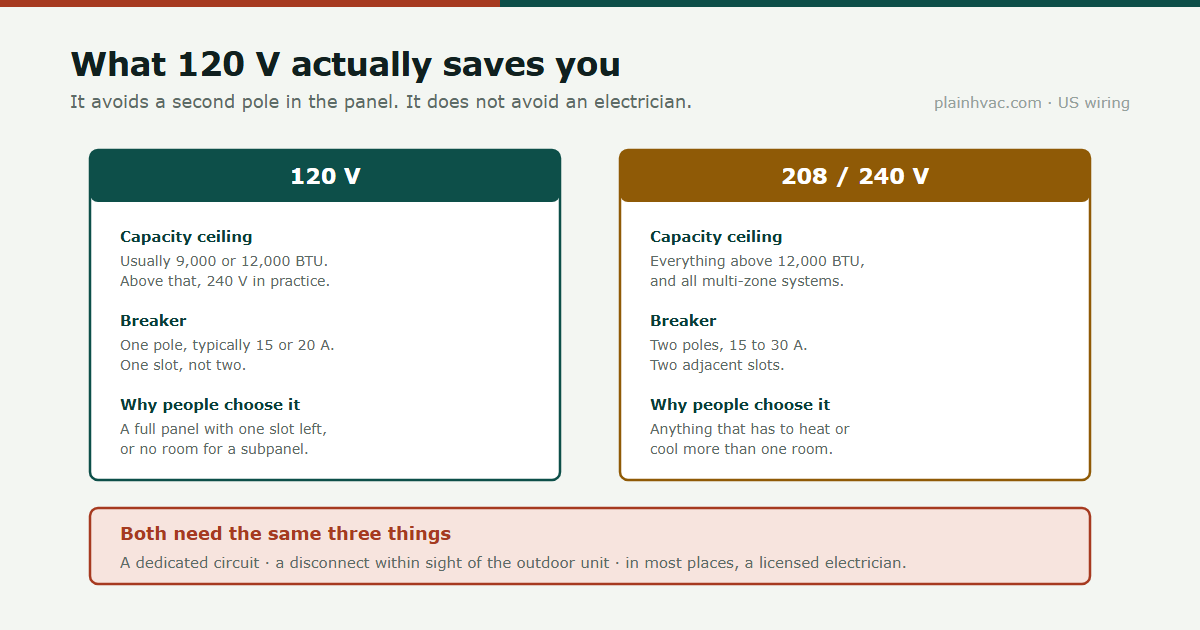
What a 120V mini split still needs
Almost all of them are hardwired. Power runs from a dedicated breaker in your panel, out to a weatherproof disconnect within sight of the outdoor unit, and into the condenser. That is the same chain of components a 240 V unit needs. The only thing 120 V removes is the second pole.
A minority of small units genuinely do ship with a cord and a standard plug. Even those are supposed to have a circuit to themselves — share one with a fridge or a workshop outlet and you will meet the breaker on the first hot afternoon.
If a listing says “plug and play” but the specification sheet lists an MCA and an MOCP, it is a hardwired unit. Those two figures only exist for equipment wired to a dedicated circuit.
Reading the nameplate instead of the blog
Every unit publishes two numbers that settle the electrical question, and neither appears in most buying guides:
- MCA — minimum circuit ampacity. The smallest conductor the circuit may use. This sets your wire gauge.
- MOCP — maximum overcurrent protection. The largest breaker permitted. You may go smaller, never larger.
For a 12,000 BTU unit on 120 V, MCA commonly lands somewhere in the low teens of amps, which points at a 15 or 20 A single-pole breaker. For 9,000 BTU it is lower. Those are the numbers to give your electrician, and they are printed on the outdoor unit and in the manual, not on the product page.
Why the ceiling sits around 12,000 BTU
It is arithmetic rather than a marketing decision. Power is volts times amps, so halving the voltage doubles the current for the same output. A branch circuit has a practical ceiling, and continuous loads are limited to 80 % of the breaker rating.
By the time you want more than about 12,000 BTU, the current a 120 V supply would need has outgrown a normal branch circuit. That is why the larger single-zone units and every multi-zone system are 240 V. It is not that manufacturers will not build them.
Check the panel before you choose the voltage
People reach for 120 V assuming a panel upgrade is the alternative. Often it is not. Work through this before you buy:
- Open the panel door and count genuinely free slots — not blanked ones you assume are free.
- Look for tandem or half-height breakers already fitted. Their presence usually means the panel is at its circuit limit even if slots look available.
- Read the panel label for its bus rating, typically 100, 150 or 200 A. Slots are not the only constraint; total capacity matters too.
- Ask an electrician for a load calculation if the house already runs an electric range, dryer, water heater or EV charger. That is a half-hour of their time and it is the only number that actually answers the question.
- Then pick the unit. If two slots exist, 240 V is usually the better system and the voltage question disappears.
The order matters. Choosing the equipment first and discovering the panel second is how people end up with an undersized unit they did not need to accept.
Where 120 V is genuinely the right answer
| Situation | Verdict |
|---|---|
| One room up to about 500 sq ft (46 m²), panel nearly full | Good fit |
| Garage, workshop or office addition on an existing sub-panel | Good fit |
| Rental where major electrical work is not permitted | Good fit — with the landlord’s consent |
| Primary heat in a cold climate | No. The capacity ceiling is the problem |
| Two or more rooms | No. Multi-zone is 240 V |
| Panel has two free slots and spare capacity | Take the 240 V unit. More choice, more headroom |
The trade you are actually making
At the same capacity, a 120 V and a 240 V unit perform comparably; you are not buying a worse machine. What you give up is headroom and selection. The 120 V catalogue is small, skewed to the bottom of the range, and you cannot grow into it later without redoing the circuit.
There is also a quieter cost. Running at twice the current for the same output means marginally higher losses in the conductors, which is real but small compared with the difference between models. If efficiency is the deciding factor, compare the published ratings on ENERGY STAR listings rather than reasoning from voltage.
Worth knowing before you commit: a unit that is left powered but not running still draws something, and on a mini-split that draw is larger and stranger than most people expect.
Frequently asked questions
Can I plug a 120V mini split into a normal outlet?
Only if it was sold with a cord and plug, and even then it should have the circuit to itself. Most 120 V mini-splits are hardwired and cannot be plugged in at all.
Do I still need a permit for a 120 V unit?
Usually yes. Permit requirements follow the installation, not the voltage — the rules on what you may legally do yourself are the same either way.
Can I convert a 120 V unit to 240 V later?
No. The voltage is designed into the electronics. Converting means a different unit.
Is a 120 V unit cheaper to install?
Modestly, and only on the wiring. Single-pole breaker, lighter cable, no panel upgrade. The mounting, the line set and the disconnect cost the same, and the position still has to satisfy drainage and routing.
Do 120 V units heat as well as they cool?
They fall off in cold weather like any small unit, and the capacity ceiling that limits cooling limits heating harder, because heating demand rises exactly when output drops.
The other limits worth knowing before you buy
Voltage is one constraint of several, and the rest bite later: the four line set limits, what you may legally install yourself, and whether the budget brands hold up.
Electrical codes vary by jurisdiction and I am not an electrician. If you are, and something above would fail inspection where you work, say so below and it gets corrected.
Scope note. Voltages, breaker conventions and permit rules here describe North American practice and do not transfer to the UK, EU or Australia, where single-phase supply is around 230 V and the question does not arise in this form. Circuit installation is licensed work in most jurisdictions. The MCA and MOCP on your unit’s nameplate are the authority for its circuit, not this page. Anything involving refrigerant requires EPA Section 608 certification.