
A MERV 13 filter will not choke your system because of its rating. It will choke your system because of its thickness and the static pressure your ductwork was already running. Those are two different questions, and almost every argument about this topic collapses them into one. Get a four-inch MERV 13 into a properly sized filter cabinet and you can filter better and breathe easier at once. Force the same rating into a one-inch slot on a system already running tight, and you have a problem.
A MERV 13 filter’s rating is not its resistance
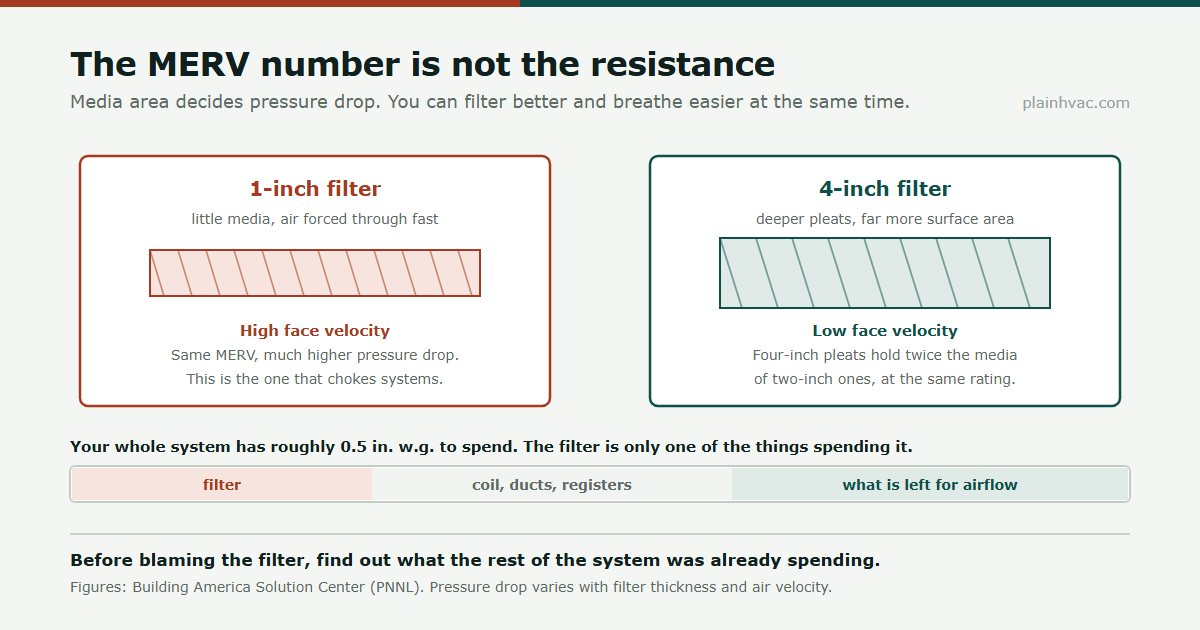
MERV describes what the media catches. Pressure drop describes how hard your blower has to push to get air through it. You can change one without changing the other, and the lever is surface area.
The Building America Solution Center, the US Department of Energy’s building science resource, puts the mechanism plainly: filters with deeper pleats or more pleats tend to have lower pressure drop, because the extra media area lowers resistance without changing the MERV rating. It gives the scale too: a filter with four-inch pleats has twice the surface area of one with two-inch pleats.
This is why the folk wisdom fails. “High MERV restricts airflow” is true of thin high-MERV filters and often false of thick ones. The honest version is that face velocity restricts airflow, and thickness is how you control it.
The budget you are spending from
Your system has a fixed allowance of static pressure, and every component spends part of it. The same source gives the working figure: most residential systems operate efficiently when total pressure drop across the system stays no higher than 0.4 to 0.5 inches of water column. A variable speed air handler is most efficient between 0.3 and 0.5.
For context on what a filter takes from that: filters rated MERV 7 to 14 and above can drop anywhere from 0.05 to 0.3 inches WC, depending on thickness and air velocity. A four-inch MERV 12 example runs about 0.2 inches at 300 feet per minute and about 0.35 at 500.
Notice what that means. The same filter nearly doubles its resistance when you push air through it faster. Velocity, not rating, did that. And the coil, the ducts and the registers were spending from the same budget before the filter arrived, which is why two houses can get opposite results from an identical filter.
Your blower type changes the failure mode, not the verdict
This is the part consumer articles get wrong in an interesting way. They tend to say a variable speed blower “handles” a restrictive filter. It does not handle it so much as absorb it, and the bill arrives differently:
- PSC motors run at a fixed speed and cannot compensate. Add resistance and airflow simply falls, run times stretch out, and overall energy use can rise even though the motor itself draws less.
- ECM motors do the opposite. They keep chasing the target airflow as resistance climbs. The Building America guidance is blunt about where that ends: the motor will work harder and harder until it burns itself out.
So neither motor gives you a free pass. On a PSC system a restrictive filter costs you comfort and runtime. On an ECM system it costs you watts now and a blower motor later. The ECM case is worse precisely because nothing feels wrong until something expensive fails.
Work out what your cabinet can actually take
Before choosing a rating, establish what the system will physically accept, because that decides whether the thickness argument above is even available to you.
- Find where the filter lives. Either in a slot at the air handler, or behind a large return grille in a wall or ceiling, or both. Houses with several return grilles sometimes have a filter behind each one, and people routinely change one and forget the rest for years.
- Measure the slot, not the old filter. Filters are sold by nominal size, and nominal is not actual: a filter printed 20×25×1 is deliberately made slightly smaller so it will slide in. Measure the opening and buy to that, using the printed nominal size that corresponds.
- Measure the depth you have available. This is the one that decides everything. A one-inch slot can sometimes be replaced with a media cabinet taking a four- or five-inch filter, which is a real improvement in both filtration and resistance, and it is sheet metal work at the air handler rather than a filter purchase.
- Look at how well it seals. Air takes the easiest route, and a gap at the edge of a filter is a far easier route than the media. A filter that rattles in an oversized slot, or a filter grille whose door does not close on its gasket, is filtering a fraction of what passes it. The symptom is a coil that gets dirty anyway, which people then blame on the filter rating.
- Check which way round it goes. The arrow points in the direction of airflow, towards the blower. A filter fitted backwards still filters, but it loads unevenly and its frame is not supported in the direction the pressure pushes.
If the honest answer is that you have a one-inch slot in a system with no measured headroom, that is useful to know: it means the productive conversation is about a media cabinet or about the return ducts, not about which box to buy at the shop.
What to actually do, in order
- Measure before you argue. Total external static pressure takes a technician about ten minutes with a manometer. Without that number, everything else in this debate is opinion. Ask for it at your next service visit.
- Go thicker before you go lower. If your cabinet takes a four-inch filter, a four-inch MERV 13 filter is usually the better answer than dropping to MERV 8 in a one-inch. You gain filtration and lose resistance at the same time.
- If you are stuck with one-inch, choose a pleated filter with a high pleat count, and change it more often. A loaded MERV 13 filter is a restrictive filter regardless of what it started as.
- Look at the rest of the budget. Undersized return ducts are the most common reason a system has no headroom, and no filter choice fixes that. Leaky ducts are the other: which ducts you can seal yourself.
Signs you have already run out of headroom
- Whistling or a strong suck at the return grille.
- Rooms that never balance, no matter how you set the registers. That often points at distribution rather than filtration: why the bypass damper is not a fix.
- A system that runs and runs without reaching setpoint. On a heat pump this also drags in the backup heat, which is its own expense: why auxiliary heat runs so much.
- A filter that visibly bows in its frame, or gets sucked against the grille. That is your system telling you the answer without a manometer.
A filter’s resistance is not fixed — it rises as it loads
Every figure quoted for pressure drop is for a clean filter. In service it only goes one way. As the media collects particles the gaps between fibres narrow, resistance climbs, and a filter that was comfortably inside your budget on the day you fitted it can be outside it a few months later. The system does not announce this; it just quietly delivers less air, or on an ECM blower, quietly draws more power to deliver the same.
Two practical consequences:
- Thickness buys time as well as headroom. A four-inch filter holds far more dust before its resistance rises meaningfully, which is why media cabinets are often specified for six- or twelve-month intervals while a one-inch filter in the same house wants changing every one to three months.
- Looking at it is a poor test. Fine media goes grey early and keeps working, while a filter that still looks acceptable can be well past its useful resistance. By the time a filter looks dramatic it has been restricting for a while.
What works better than inspection is a date. Write the date of fitting on the edge of the frame in marker pen, and set a reminder matched to your house rather than to the box: shorter with pets, a shedding carpet, a smoker, nearby construction or a heavy pollen season, and shorter again while any building work is going on inside, which fills filters faster than anything else a house does.
The underrated failure mode here is a filter that is too good for the interval it gets. A high-rated filter changed religiously is better than a low-rated one; the same filter left in for a year is worse than either, because its rating stops mattering once its resistance has taken the system’s remaining headroom. Choose the rating you will actually maintain.
When filtration is the wrong tool entirely
A better filter cleans the air that passes through it. It does nothing about sources, and it only works while the fan runs. If the complaint is a smell, damp, or something arriving from outside, filtration is the wrong lever and the EPA on indoor air quality is the better starting point. Humidity in particular is not a filtration problem at all: whole house dehumidifier versus portable.
The line between checking and changing
What this article covers: choosing filter rating and thickness, and understanding what restricts airflow.
What it does not cover: modifying a filter cabinet, resizing return ducts, altering blower speed taps, or measuring static pressure yourself, which needs a manometer and drilling test ports.
Stop and call someone if the blower is overheating or cycling on a limit switch, the filter collapses into the cabinet, or you find the filter has been missing entirely. A system run without a filter deposits on the coil, and that is a cleaning bill rather than a filter bill.
Static pressure readings from real systems would improve this article more than anything I can add from published tables. If you carry a manometer for a living, I would welcome your numbers below.