
Zoning a single-stage system is possible, it is sold every day, and it is a compromise from the first minute. The reason is not the dampers. It is that a single-stage blower moves the same volume of air whether one zone is calling or all of them are.
Close half the outlets and that air has to go somewhere. Everything that goes wrong with these installations follows from that one sentence.
What actually happens when a damper closes
Your blower is designed to push a set airflow against a set resistance. Shut a zone and the resistance rises, so static pressure in the supply plenum climbs. Three things follow, in this order:
- Duct noise. Air forced through the remaining openings moves faster, and speed is what you hear. This is usually the first complaint.
- Reduced airflow across the coil. The blower is working against more resistance than it was selected for, so it moves less air overall — not more into the open zone, as people assume.
- A cold coil. Less air across the same refrigerant means the coil runs colder than designed, and eventually it ices. Once it ices, airflow drops further, which makes it colder still.
That last loop is why the failure is not gradual. It is fine, fine, fine, then the system stops cooling on the hottest afternoon of the year.
The bypass damper, and why it is not the fix
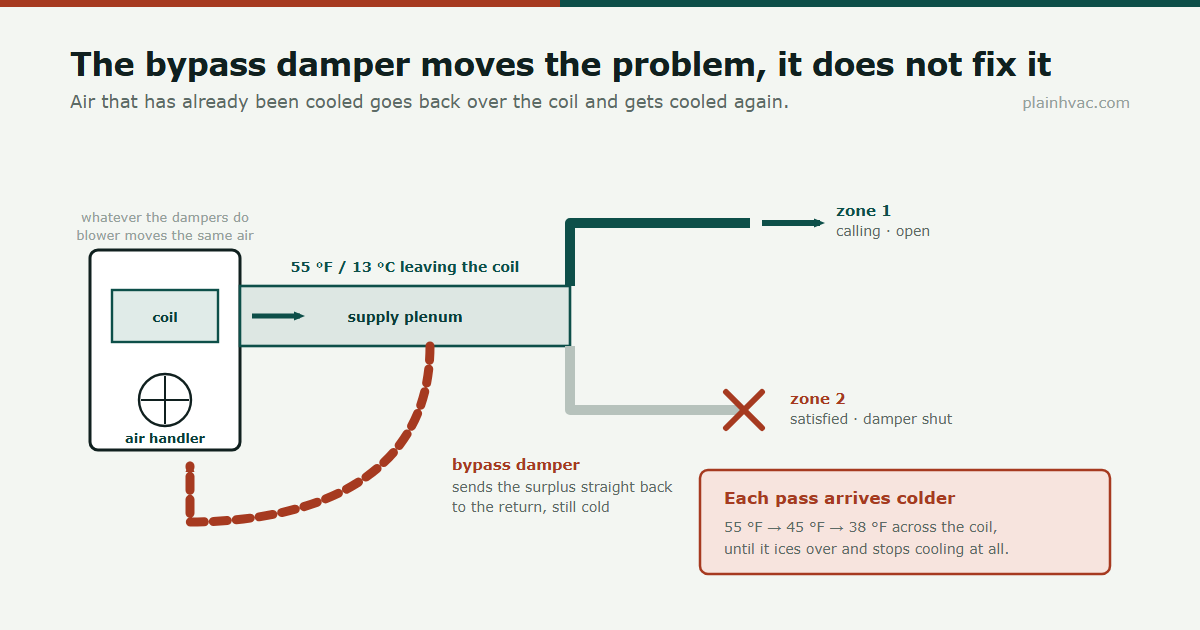
The standard answer is a bypass damper: a duct from the supply plenum back to the return, with a weighted or motorised damper that opens when static pressure gets too high. It relieves the pressure, and on that narrow measure it works.
The problem is what it relieves the pressure with. It takes air that has just been cooled to about 55 °F (13 °C) and feeds it straight back into the return, where it goes over the coil again.
The second pass leaves colder. The third colder still. You have built a small refrigeration loop that cools nothing in the house and drives the coil temperature down towards freezing — the exact failure the bypass was installed to prevent.
In heating it is the mirror image: recirculated hot air raises the supply temperature until the furnace hits its high-limit switch and shuts down on a safety.
Symptoms of an over-zoned single-stage system
| What you notice | What is happening |
|---|---|
| Whistling or roaring from registers when one zone runs | Static pressure too high for the open path |
| The open zone is not much better than before | Total airflow has dropped, not shifted |
| Coil ices in cooling, or the furnace short-cycles in heating | Recirculation through the bypass |
| The blower is noticeably louder in some zone combinations | Only some combinations leave enough open path |
| Energy use rose after zoning was added | The blower is working harder for less delivered air |
If several of those appeared at the same time as the zoning system, the zoning system is the cause and no amount of thermostat adjustment will fix it.
What works instead
There are three honest answers, and the right one depends on how much you are willing to change.
Variable-capacity equipment
This is the real solution. An inverter compressor and a variable-speed blower can throttle down to match a single zone calling — a quarter of the demand gets roughly a quarter of the output, with no pressure spike and no bypass. Zoning was designed for this kind of equipment, not retrofitted onto single-stage. If you are replacing the system anyway, compare the variable-speed models on the ENERGY STAR listings before you spend money on dampers.
Fewer, larger zones, and no bypass
Two generously sized zones can work on single-stage, provided the smallest zone still passes enough air on its own to keep the coil happy. That is a duct design calculation, not a guess. A common approach is a dump zone — a zone that always stays open, usually a hallway or a large open space — instead of a bypass. It relieves the pressure with air that actually goes into the house.
Do not zone the ducts at all
If the problem is one room that never gets comfortable, the cheapest reliable fix is often to leave the ducted system alone and put a mini-split in that room. It gives genuine independent control, it does not touch the static pressure of the existing system, and for a single room a 120 V unit may avoid electrical work entirely.
That is worth taking seriously before spending on dampers and a control panel. Zoning a duct system is an attempt to make one machine behave like two. Sometimes buying the second machine is simply cheaper and works better.
When zoning a single-stage system is genuinely fine
- Two zones only, both large, with ductwork sized generously to begin with.
- A dump zone rather than a bypass, so relieved air still reaches the house.
- Measured static pressure before and after, not assumed. This is a five-minute test with a manometer that most installers own and few perform.
- Minimum airflow enforced in the zone controller, so it will not run a combination that starves the coil.
If your installer proposes exactly this, they know what they are doing. If they propose four zones and a bypass on a single-stage furnace, they are selling a kit rather than designing a system.
Frequently asked questions
Can I add zoning to a single-stage system myself?
The dampers and controller are within reach for a competent DIYer, but the part that determines whether it works is the duct and static pressure calculation, which is not. This is one to design professionally even if you install it yourself.
Is a bypass damper always wrong?
Not always, but it is a last resort rather than a default. Where a dump zone is possible, it is the better answer for the same money.
My system already has a bypass and it works fine. Should I change it?
If nothing is icing, short-cycling or roaring, leave it alone. Plenty of these installations run acceptably for years. The advice here is about what to build, not what to rip out.
Does two-stage equipment solve it?
Partly. Two stages give you two airflow levels rather than one, which helps, but it is still coarse compared with a modulating system. It is a real improvement over single-stage and short of the full answer.
Will zoning save me money?
On a single-stage system, often not. The blower works harder, the bypass wastes conditioned air, and the savings from not conditioning empty rooms get eaten. On variable-capacity equipment the arithmetic is genuinely favourable.
Before you add anything else to the ductwork
Zoning adds resistance to a system that may have none to spare. Find out what it already spends: four tests for not enough return air. And if someone has offered you the cheaper alternative, it carries a trade nobody mentions: what a booster fan can and cannot move. The filter spends from that same headroom: what actually decides whether it chokes your system.
Zoning done well is a genuine craft, and this article argues against the cheap version of it. If you design zoned systems and think I have been unfair to the bypass damper, make the case in the comments. I will run it if it holds.
Scope note. Temperatures here are illustrative of the mechanism rather than measurements from a specific system. Duct design, static pressure limits and minimum airflow for your equipment are in the manufacturer documentation and in a proper load and duct calculation — both take precedence over this page. Work inside the air handler or on the control wiring is licensed work in most jurisdictions.