
Seeing heat pump auxiliary heat on the thermostat does not mean something has failed. It means resistance heat is running alongside the compressor, and there are exactly three reasons that happens: your own thermostat schedule, a setting somebody left wrong at installation, or a genuine fault. The first two are free to fix and account for most cases. Work through them in that order before anyone bills you for a diagnostic.
What it costs, and why the answer is counterintuitive
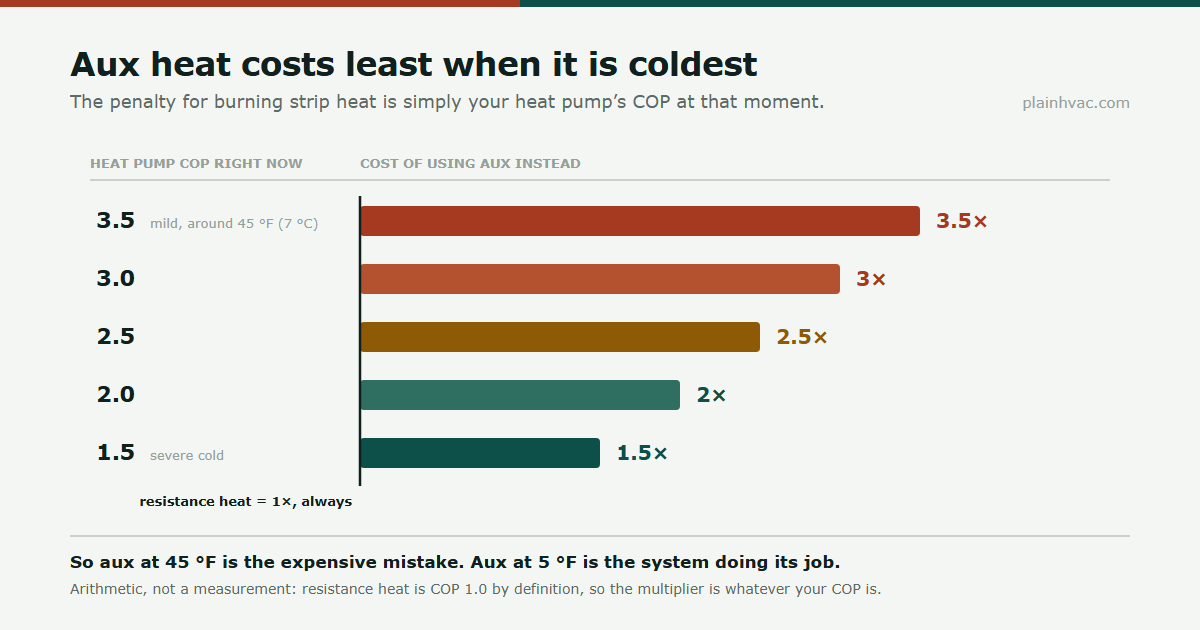
Electric resistance heat is 100 per cent efficient. That sounds good and is actually the problem, because a heat pump is several hundred per cent efficient: it moves heat rather than making it. The ratio between them is the coefficient of performance, and it is the entire story.
So the penalty for burning aux is not a fixed number. It is whatever your heat pump’s COP happens to be at that moment. If the compressor would have delivered heat at a COP of 3, then aux costs three times as much for the same warmth. At a COP of 1.5, it costs one and a half times as much.
Which leads somewhere most articles never go. A heat pump’s COP falls as it gets colder, so the penalty for aux heat shrinks exactly when you need aux most. Aux running at 5 °F (−15 °C) is the system doing the job it exists for, at a modest premium. Aux running at 45 °F (7 °C) is money set on fire: at that temperature the compressor would have delivered the same heat for a third of the cost.
That is the test worth internalising. Do not ask whether heat pump auxiliary heat is on. Ask at what outdoor temperature it is on.
Cause one: your thermostat schedule, which is the usual answer
When a thermostat sees a large gap between the room and the setpoint, most controls treat that as an emergency and bring on resistance heat to close it quickly. A deep overnight setback, then a sharp morning jump, is the single most common way people run up an electric bill without touching a broken part.
The standards bodies know it too: the ENERGY STAR specification for programmable thermostats tackles it head on, requiring thermostats for heat pumps to carry a recovery feature. The specification puts it plainly: the heat pump recovery feature is designed to minimise the use of auxiliary heat while also minimising the on-time of the system. The feature exists precisely because the naive behaviour is expensive.
What to do: reduce the depth of the setback, or check that your thermostat treats the system as a heat pump and has recovery switched on, rather than running as a generic furnace. A thermostat installed on the wrong equipment type will cheerfully do the expensive thing forever.
Cause two: a setting left wrong at installation
Two settings decide when aux is allowed to run, and installers frequently leave both on defaults that suit nobody:
- Aux lockout temperature. Above this outdoor temperature the system simply will not run resistance heat. If nobody ever set it, aux can engage on a mild day when the compressor had plenty of capacity left.
- The droop, or differential. How far the room may fall below setpoint before aux joins in. Set it too tight and any ordinary fluctuation calls for resistance heat.
Neither costs anything to change, and both live in installer settings rather than the everyday menu. This is the same category of problem as the switchover point on a dual fuel system, where the default is also usually wrong and also usually expensive: the default switchover temperature is probably wrong.
Cause three: an actual fault
Only now is it worth suspecting the equipment. Heat pump auxiliary heat runs constantly because the compressor cannot carry the load, so anything that weakens the compressor side produces this symptom:
- Restricted airflow. A blocked filter or a closed-down duct system starves the coil. Cheap to check, and the first thing to rule out. If the ducts leak on top of that, the compressor is fighting a load it was never given a fair chance at: which ducts you can seal yourself.
- A defrost cycle that is not ending, or one running far too often. Some defrost is normal in cold damp weather and briefly brings aux on by design.
- Low refrigerant charge, which quietly removes capacity long before it stops the system.
- A failing reversing valve, where the unit no longer commits properly to heating.
The last three need a technician with gauges. Before you call, note the outdoor temperature when aux appears and how long the outdoor unit runs between cycles. That single observation shortens most diagnostics considerably, and it is free. If the outdoor unit is also making a noise it did not used to make, that is a separate clue worth reading first: what outdoor unit noises actually mean.
How to tell the three apart in one week
- Does aux appear within an hour or two of a scheduled temperature rise? That is recovery. Cause one. Flatten the schedule and watch it disappear.
- Does aux appear in mild weather at a steady setpoint, with nothing scheduled? That is a lockout or droop setting. Cause two.
- Does aux run while the outdoor unit is not running at all, or runs constantly without ever satisfying? That is cause three, and it is worth a call.
Write down the outdoor temperature each time. A week of that beats any amount of guessing, and it is the difference between a free fix and a service charge.
One more possibility sits behind all three: the heat pump may be the right size and simply losing to the house. A building that leaks heat faster than the compressor can replace it will call for aux no matter how well the equipment is set up, and finding that out costs nothing but an afternoon: how to find air leaks without a blower door test.
What to leave to a technician
What this article covers: interpreting heat pump auxiliary heat behaviour and adjusting thermostat schedules and configuration.
What it does not cover: changing refrigerant charge, replacing a reversing valve, working inside the air handler, or touching resistance heat elements, which run on high-current circuits.
Stop and call someone if you smell burning, find a tripping breaker, see ice that never clears from the outdoor unit, or find the emergency heat setting has been left on. Emergency heat bypasses the compressor entirely and runs the house on resistance alone. Leaving it on by accident is the most expensive switch position in the house.
One number worth knowing before you change anything
All of the arithmetic above turns on your electricity rate, because a multiplier only matters against a price. Check what you actually pay per kilowatt hour before deciding how hard to chase this. In a cheap-power region, a modest amount of aux is a rounding error. In an expensive one, the same behaviour is the difference that shows up on the bill, and the free fixes above are worth the afternoon.
Thermostat firmware differs enough that the settings above may carry different names on yours, or sit somewhere else in the menu. If you know a common model where this advice does not hold, say so in the comments.