
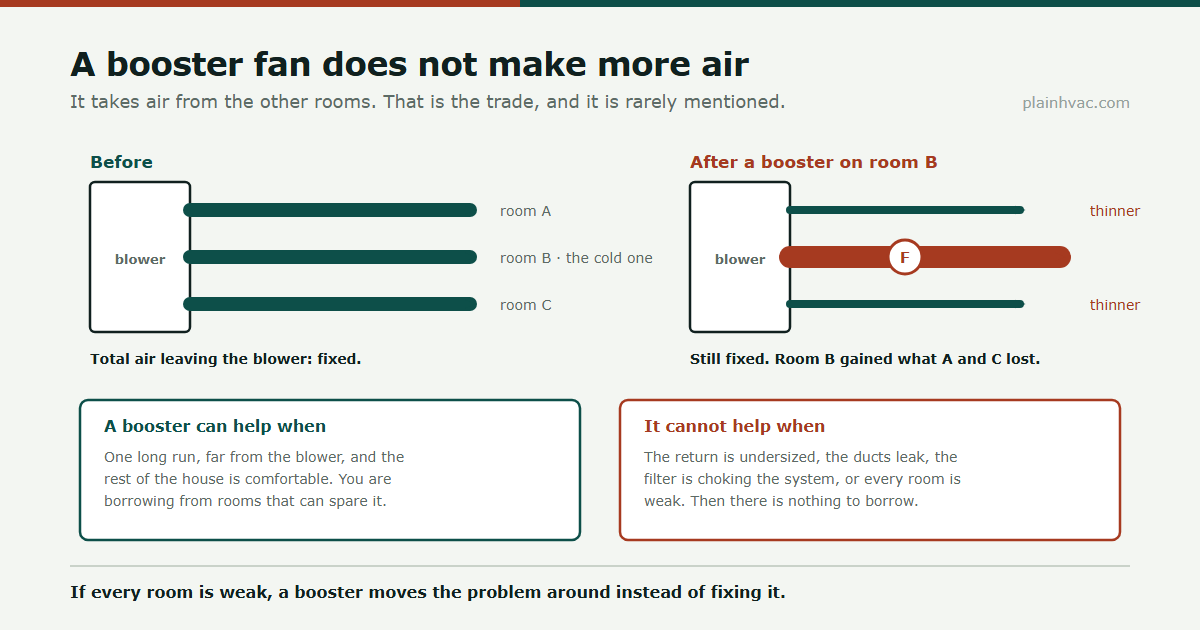
A duct booster fan can genuinely help one stubborn room, and it helps by taking air away from the other rooms. Your blower moves a fixed amount of air. Nothing you bolt into a branch duct changes that total, so every cubic foot the cold bedroom gains, the rest of the house loses. Whether that trade works for you depends entirely on whether the other rooms had air to spare.
Why a duct booster fan cannot create airflow
The blower sets the total. A booster sitting in one branch lowers the resistance of that branch relative to the others, so a larger share of the same air goes down it. That is redistribution, not production.
This matters because of how people arrive at the purchase. The usual story is one room that never keeps up, so the fan looks like a targeted fix. It is targeted, but it is targeted at the symptom. If the rest of the house sits comfortably, borrowing from it is a reasonable trade. If every room is already weak, you have just moved the weakness around.
The two products people confuse
- Register booster fans sit in the vent opening and plug into a wall socket. They are cheap, tenant-friendly, and easy to fit. They also pull air through a grille that was never designed for it, and they are noisy in a bedroom, which is where people usually want them.
- Inline duct booster fans mount into the branch duct itself, usually near the trunk, and wire into the system so they run with it. More effective, more invasive, and more likely to need an electrician.
Both work on the same principle and both carry the same trade. The inline version simply does it better.
Is it the airflow, or is it the room?
Before any of this, there is a question worth answering, because roughly half the rooms people buy booster fans for do not have an airflow problem at all. They have a load problem: the room loses or gains more heat than the air it receives can make up, and it would be uncomfortable even with a perfectly proportioned share of the system.
The test is free and takes no equipment. Ask what the room does in the opposite season.
- Cold in winter and hot in summer — that is a load problem. The room is losing in one direction and gaining in the other, which is what an exterior-heavy room does. Bonus rooms over garages, additions, attic conversions, rooms with three outside walls, rooms with large or west-facing glazing, and rooms above unheated space all behave this way. More air helps a little. Insulation, air sealing and shading help properly.
- Weak in both seasons, with air that barely moves — that is a delivery problem, and the rest of this article applies.
- Uncomfortable only at a particular time of day — usually solar gain, sometimes a thermostat schedule, almost never a duct.
Hold a tissue to the register while the system runs. If it lifts firmly and the room is still wrong, you are not short of air. If it barely stirs, you are, and the causes below are where to look.
The closed door, and the free fix most people miss
One cause deserves separating out, because it is common, it is invisible, and it costs nothing to fix. A bedroom typically has a supply register and no return of its own. With the door open, air comes in through the register and leaves through the doorway. With the door shut, it has nowhere to go.
The room then pressurises slightly, and that pressure pushes back against the incoming air until the flow falls off. The air it does receive gets forced out through whatever gaps exist in the exterior walls and ceiling, while the rest of the house goes slightly negative and pulls replacement air in from outside. The occupant experiences a room that is fine during the day and stuffy or cold overnight — exactly the room people put a noisy fan in.
The test: shut the door, run the system, and hold the tissue to the register again. Markedly weaker with the door closed than with it open means the room cannot exhaust what it is given. The remedy is a return path, not more supply: an undercut at the bottom of the door with real clearance, a transfer grille through the wall above the door, or a jumper duct into the hallway ceiling. All of them are quieter and cheaper than a booster fan, and none of them take airflow from anywhere else in the house.
Find the real cause first, because there usually is one
A weak room is a symptom with a short list of causes, and a booster fan only addresses the last of them:
- The return is undersized. The blower cannot push what it cannot pull, and a starved return weakens every supply in the house at once. This is the most common cause of whole-house weakness, and a booster does nothing for it: four tests for not enough return air.
- The filter is eating your headroom. the Building America Solution Center notes that most residential systems have only about 0.4 to 0.5 inches of water column to spend across the whole system. A restrictive filter can take a surprising share of that: what actually decides whether a filter chokes your system.
- The ducts leak before they reach the room. ENERGY STAR puts typical duct losses at 20 to 30 per cent of the air moving through the system. Boosting a leaky run just pushes more air into your crawlspace: which ducts you can seal yourself.
- The branch is genuinely long or undersized. Only now does a booster make sense, and only if the rest of the house can spare the air.
When a booster is the right answer
There is a real case for one, and it looks like this. A single long run, usually to a bonus room over a garage or an addition tacked onto an older house. The rest of the house holds temperature comfortably. Nothing else on the list above applies. In that situation you are borrowing from rooms that will not notice, and the fan earns its place.
There is also a case where a booster is the wrong shape of answer entirely. If one room needs fundamentally different treatment from the rest of the house, moving air around with a fan is a weaker version of zoning, and zoning has its own well-known trap: why the bypass damper is not a fix.
Before you buy: the free version of the same experiment
You can test the trade without spending anything. Close down the dampers or registers serving the comfortable rooms by a quarter turn each, then wait a full day and see whether the problem room improves.
That experiment tells you what you need to know. If the room improves, redistribution works in your house, and a duct booster fan will do the same thing more precisely and without you giving up airflow elsewhere by hand. If the room does not improve, redistribution is not your problem, and the fan would have been money wasted.
One caution while you experiment: do not close registers completely across the house. Choking too many branches raises static pressure, which makes the blower work harder and can make every room worse.
What a booster fan costs you after it is fitted
The purchase price is the smallest part of the decision. The things that determine whether you are still happy with it in two winters are these.
- Noise, in the room least able to tolerate it. Boosters are overwhelmingly bought for bedrooms. A register fan sits a metre from a pillow and runs whenever the system does. The inline version, mounted back near the trunk, is substantially quieter at the register for exactly that reason, and this is the main argument for the more invasive product.
- How it knows when to run. This is the detail that separates a fan that helps from a fan that makes things worse. Some are manual, which means they get left on. Some use a pressure switch in the duct, some a current sensor on the air handler, and some simply run continuously. A booster running while the blower is off does not warm anything; it pulls room-temperature air through a cold duct and into the room, and in cooling season it can do the same with humid air from an unconditioned space.
- What happens when it dies. The point that gets left out of every product page: an inline booster that has failed is not a neutral object. It is a stalled fan sitting in the middle of the duct, and it restricts that branch more than the bare duct ever did. The room ends up worse than before it was fitted, and because the failure is silent and buried, it is rarely connected to the complaint.
- Electricity, which is the least of it. These are small motors, and the running cost is not usually the argument against them.
- Access. Fit an inline fan somewhere you can reach it again. It has bearings, it collects dust, and it will eventually need attention.
None of this means do not fit one. It means the question is not “will it move more air into this room” — it will — but whether, two years from now, the room is better and nothing else is worse.
What you can fit yourself, and what you cannot
What this article covers: deciding whether a booster fan suits your situation, and what to rule out first.
What it does not cover: cutting into ductwork, wiring an inline fan to the air handler, resizing ducts, or measuring static pressure, which needs a manometer and test ports.
Stop and call someone if you find the blower overheating or tripping a limit, a duct disconnected inside a wall or ceiling, or you would need to work on a live 24 V control circuit to wire the fan. A register fan that plugs into the wall is genuinely a homeowner job. An inline fan usually is not.
If you have fitted booster fans and seen them work where this article says they should not, or fail where it says they should help, that contradiction is exactly what I want to hear. Comments are open.