
Ice on a heat pump outdoor unit in winter is not a malfunction. It is the predictable result of a cold surface sitting in damp air, and every heat pump is built to handle it by running a defrost cycle several times a day. What separates normal from broken is not whether there is ice. It is where the ice sits, and whether it clears.
Why ice on a heat pump forms, and why mild weather is worst for it
In heating mode the roles you know from summer are reversed. The outdoor coil is the cold side, held deliberately colder than the outdoor air so that heat flows into it. When its surface is both below freezing and below the dew point of the air around it, moisture condenses onto it and freezes. That is not a design flaw; it is the unavoidable consequence of extracting heat from cold air.
Which leads somewhere most people find surprising. The worst frosting weather is not the coldest weather. Around 30 to 40 °F (−1 to 4 °C) with fog, drizzle or melting snow, the air is carrying a great deal of moisture and the coil sits just below freezing: ideal conditions for building frost quickly. At 5 °F (−15 °C) the air is dry and there is very little moisture available to deposit. A unit that ices heavily on a damp November morning and barely at all in a hard January frost is behaving exactly as expected.
What a defrost cycle looks like from outside
To clear the coil, the unit briefly reverses itself. The reversing valve flips, hot refrigerant is sent out to the outdoor coil, and the frost melts off. The outdoor fan stops during this, because blowing cold air across the coil would defeat the point. Indoors, resistance heat usually comes on for those few minutes so you do not get a cold draught from the vents.
From the garden that looks like: the fan stopping while the compressor keeps running, a loud whoosh or clunk as the valve changes over, steam rising off the unit, and water running off it, sometimes forming a sheet of ice underneath. In frosting weather this happens roughly every 30 to 90 minutes and lasts 5 to 15 minutes.
The steam is the single most common reason people call a technician in December. It is water vapour coming off a warm wet coil, and it is the system doing its job. Because defrost deliberately brings resistance heat on indoors, it also shows up on the thermostat, which is worth knowing before you panic about that too: why auxiliary heat runs, and when to worry.
Where the ice on a heat pump sits tells you nearly everything
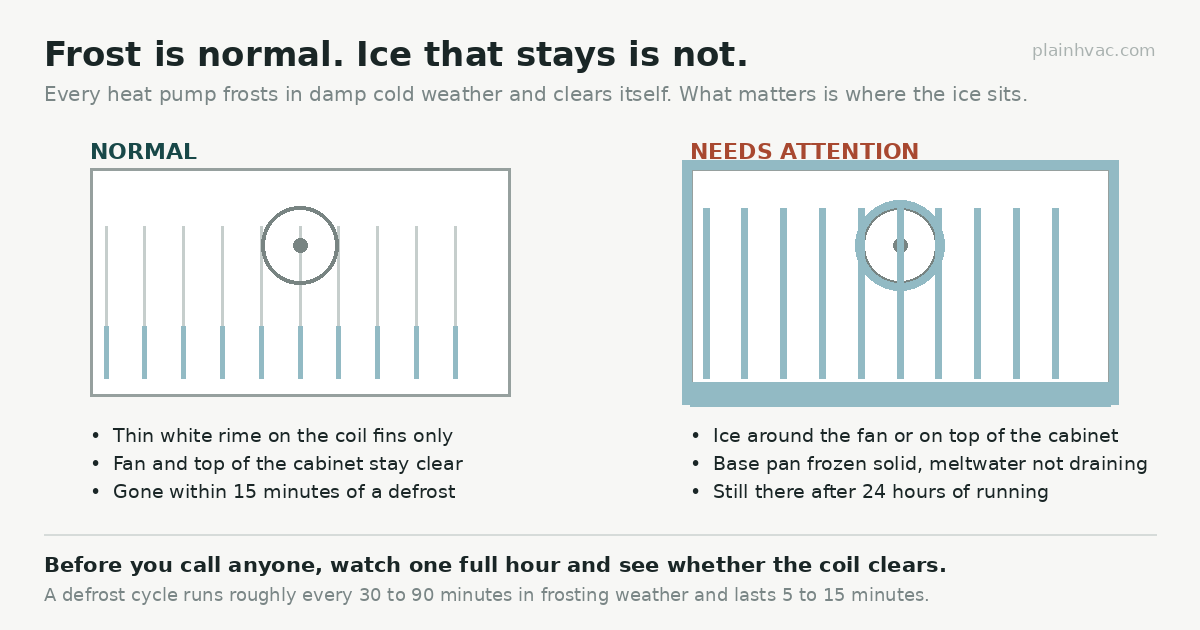
Normal. Ice on a heat pump coil looks like a thin, even white rime on the fins. The top of the cabinet and the fan stay clear. It disappears within minutes of a defrost cycle finishing.
Worth attention. Four patterns say something else is going on:
- Ice on the fan grille, the blades, or the top of the cabinet. Defrost does not put ice there. Water dripping from a gutter, a roof valley or a balcony above does. That is a siting problem, not an equipment fault, and no amount of defrosting will fix it.
- A base pan frozen solid. The drain is blocked, so meltwater cannot escape and refreezes after every cycle, building up a little more each time. Common on units set straight on the ground or on a flat pad with nowhere for water to go.
- The whole unit encased after a full day of running. At that point defrost itself is not working: a sensor, the control board, the reversing valve, or a low refrigerant charge.
- Ice plus a sound the unit did not used to make. Read the noise first, because it narrows things down fast: what each outdoor unit noise means.
Four checks on a frozen heat pump that cost nothing
- Clearance. Leaves packed against the coil, a snow drift, a winter cover somebody left on, a shrub that grew. A unit starved of airflow frosts faster and defrosts worse.
- Height. The unit should sit above the local snow line, normally on a stand, with space underneath for meltwater to drain away rather than pool and refreeze.
- What is above it. Follow the drip line. A gutter overflowing onto the cabinet will beat any defrost cycle ever designed.
- The indoor filter. Defrost borrows heat from the house. Restricted indoor airflow leaves less of it available, and the cycle struggles: four free tests for return air.
Then watch one full hour from a window, because ice on a heat pump that is working will not survive a defrost cycle. If a defrost starts and the coil comes clear, the system is fine and you have saved yourself a call-out fee.
What not to do
Never chip or scrape ice off with a tool. Not a screwdriver, not a knife, not a trowel. Coil fins and refrigerant tubing are thin aluminium and copper sitting a few millimetres behind that ice. A puncture turns a nuisance into a refrigerant leak and a serious bill.
Do not pour boiling water over a frozen unit either; the thermal shock is unnecessary. Lukewarm water poured slowly is acceptable if you need to free a fan, but understand that it treats the symptom and the cause is still there an hour later.
What to leave to a technician
What this article covers: recognising normal frost and defrost behaviour, clearing obstructions and drainage, and documenting what you see.
What it does not cover: defrost boards and sensors, reversing valves, refrigerant charge, or anything inside the cabinet.
Stop and call someone if the fan blades are locked in ice, the unit is still encased after a full day of running, a breaker trips, you hear grinding or metal contact, or you find oily residue on the pipework, which usually means refrigerant is escaping.
One observation worth more than any description
Before you call anybody, write down five things: the outdoor temperature, the time since the last defrost, whether the outdoor fan stops during it, how long it lasts, and whether the ice is on the coil only or on the cabinet as well.
That short paragraph is worth considerably more to a technician than “it is frozen”, and it costs you nothing but an hour in a warm room looking out of a window. If you want the wider picture of how these systems are meant to behave in cold weather, the US Department of Energy overview of heat pump systems is a reasonable starting point.
Defrost strategies differ between manufacturers, and some cold climate units behave differently again. If you work in the trade and this does not hold for a model you see often, say so in the comments. Corrections from installers jump the queue.