
Heat pump setback — turn the heat down at night, save money — is the most repeated piece of home energy advice there is, and it was written for a gas furnace. On a heat pump it can be exactly wrong, and the reason has nothing to do with what happens at midnight. It is what happens at six in the morning.
The rule you learned was written for a different machine
A furnace makes heat at a fixed rate and at roughly fixed efficiency, whether the room is two degrees below setpoint or ten. So the arithmetic is simple: a cooler house overnight loses less heat to the outdoors, and the morning recovery costs the same per unit of heat as any other hour of the day. Setback wins, every time.
A heat pump does not work that way. It moves heat rather than making it, and how much it moves per unit of electricity depends on the conditions and on how hard it is being asked to work. The recovery is not free, and on a heat pump it is the part that matters.
What happens at six in the morning
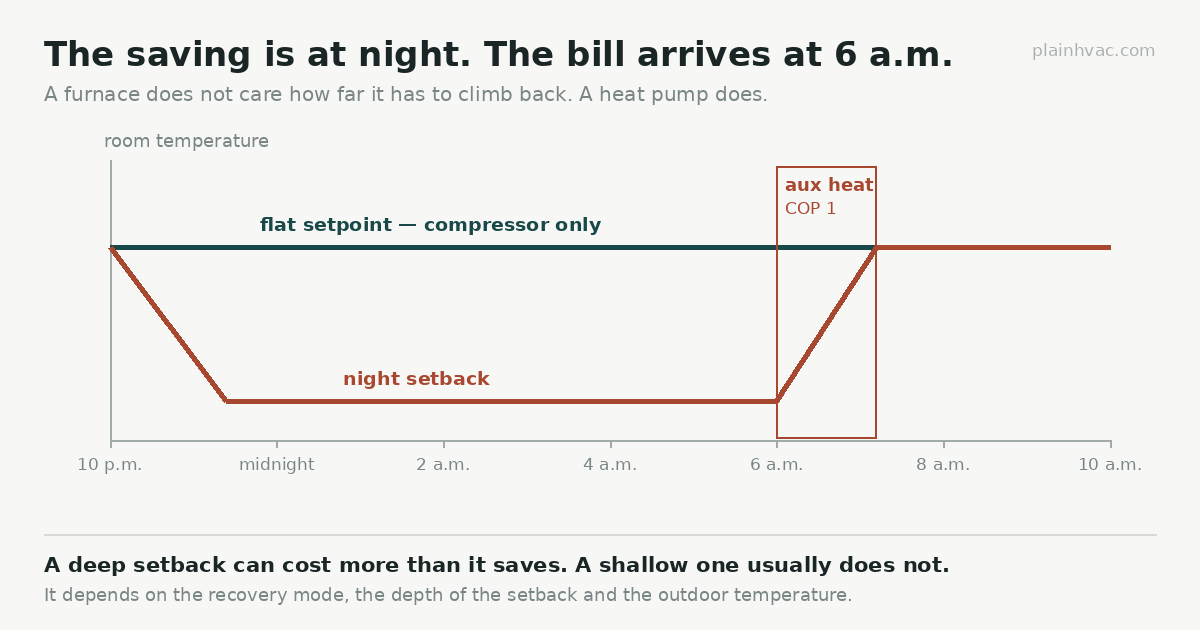
When a thermostat sees a large gap between the room and the setpoint, most controls treat that as a call for help and bring on electric resistance heat to close it quickly. Resistance heat is 100 per cent efficient, which sounds good and is actually the problem: the compressor it is standing in for would have been running at two to three and a half times that. The penalty is whatever the heat pump’s coefficient of performance happened to be at that moment, which is explained in full here: why auxiliary heat runs, and what it costs.
So the real question is not whether you set back. It is whether your recovery runs on the compressor or on resistance heat, and for how long. If it runs on resistance heat for forty minutes, you can hand back in those forty minutes rather more than you saved over the previous eight hours.
So is heat pump setback always wrong? No. Three things decide it
One: whether the thermostat knows it is driving a heat pump. The ENERGY STAR specification requires thermostats sold for heat pumps to carry a recovery feature, precisely so the system ramps up early on the compressor instead of panicking into resistance heat. A thermostat that was set up at installation as a conventional furnace will cheerfully do the expensive thing forever. This is the single most common misconfiguration in the whole subject.
Two: how deep the setback is. One or two degrees Fahrenheit, about one degree Celsius, rarely opens the auxiliary stage. Eight degrees in cold weather almost always will.
Three: how cold it is outside. In mild weather the compressor has spare capacity and recovers on its own, so the setback is a genuine saving. Near the design temperature it has no spare capacity at all, and resistance heat fills the gap by definition.
Which means a shallow heat pump setback, on a correctly configured thermostat, in mild weather, is fine. A deep setback in February on a thermostat that thinks it is running a furnace is an expensive habit.
How to find out what yours does, in three mornings
- Night one, your usual setback. In the morning, watch the thermostat during the recovery and note whether aux, auxiliary or em heat appears, and for how long. Write down the outdoor temperature.
- Night two, halve the setback. Same observation, same note.
- Night three, flat setpoint. Same again.
Three mornings and you know what heat pump setback costs you, for your house and your equipment, which is worth more than any general rule including this one. If auxiliary heat never appears, keep your setback. If it appears for forty minutes, you now know what the habit was costing.
Record the outdoor temperature every time, because the answer changes with it. A test run in October tells you very little about January.
The heat pump setback settings worth checking first
- Equipment type. Heat pump, not conventional. This lives in installer settings rather than the everyday menu.
- Adaptive or smart recovery. On. It is what lets the thermostat start early and climb on the compressor.
- Auxiliary lockout temperature. Above this outdoor temperature, resistance heat is simply not permitted.
If you run a dual fuel system, there is a fourth number with the same character: a default somebody left alone that is usually wrong and usually expensive. The default switchover temperature is probably wrong.
When the thermostat is not the problem
If recovery takes hours and auxiliary heat runs regardless of how shallow you make the setback, the schedule is not what is wrong. Either the system is short of capacity for the house, or the house is losing heat faster than it can be replaced, or airflow is strangling it. Those are all findable without spending anything: finding air leaks without a blower door, and which ducts you can seal yourself.
What to leave to a technician
What this article covers: thermostat schedules, recovery settings, and interpreting what the auxiliary indicator is telling you.
What it does not cover: wiring a thermostat, changing lockouts on equipment control boards, or anything inside the air handler, including resistance heat elements, which sit on high current circuits.
Stop and call someone if you find the emergency heat setting has been left on, a breaker trips, or the system never reaches setpoint at all regardless of schedule.
The honest summary
On a heat pump, “set it and forget it” is not laziness dressed up as advice. It is the safe default, because it never gives the thermostat a reason to call the expensive stage. A setback can beat it, and often does in mild weather, but only once you have checked on your thermostat, in your weather, that the recovery stays on the compressor.
Three mornings of looking is all that takes, and nobody can do it for you from a website. For the general background on scheduling, the US Department of Energy page on thermostats is sound, though note that most of its arithmetic assumes a furnace.
Thermostat firmware varies enough that the settings above may carry different names on yours. If you know a common model where this advice does not hold, say so in the comments. Corrections from the trade jump the queue.