
A mini split leaking water indoors is almost always leaking condensate, the water the indoor coil pulls out of the air while it cools. That water should collect in a pan and leave through a hose to the outside. When it lands on your wall or floor instead, something stopped it on the way. Where it comes out tells you roughly where.
First, switch it off and catch the water
Turn the unit off with the remote and put a towel or a tray under it. If water is running near a socket or near the unit’s wiring, switch it off at the breaker as well. Then dry the wall and the floor promptly. The EPA advises drying water-damaged areas within 24 to 48 hours to prevent mold growth, and drywall behind a slow drip stays wet far longer than it looks.
Mini split leaking water: where it comes out tells you why
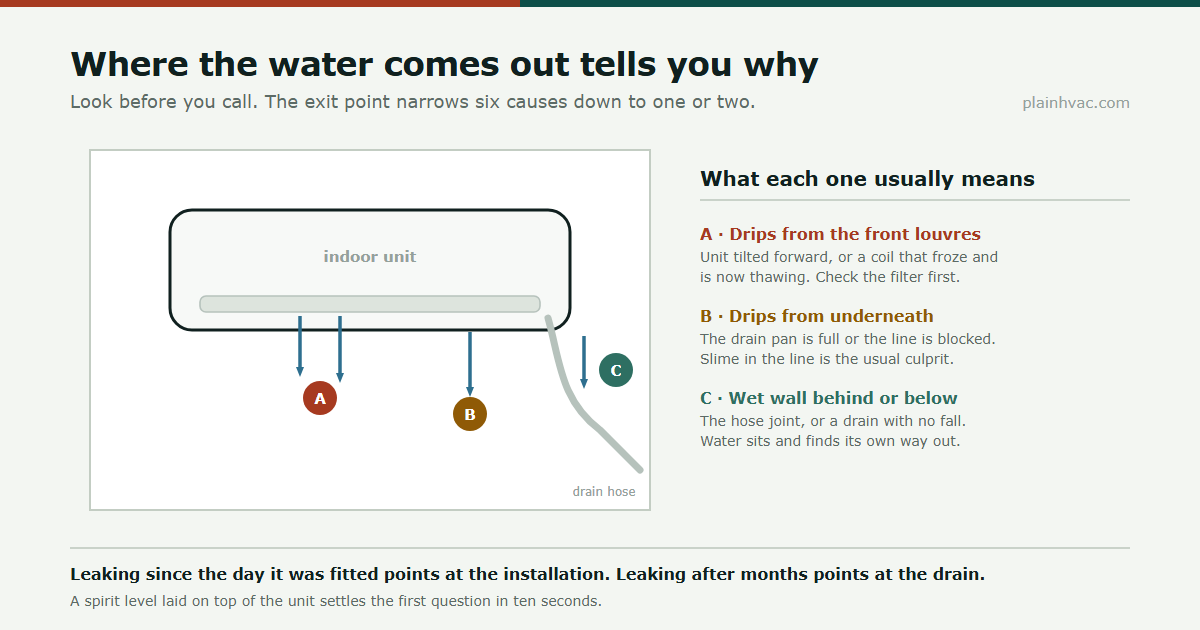
Stand in front of the unit while it runs in cooling mode and watch for a few minutes. The exit point narrows six possible causes down to one or two.
A. Drips from the front louvres
Water that falls from the front, or spits out with the air, usually means one of two things. Either the unit tilts forward, so condensate spills over the front lip of the pan instead of running to the drain. Or the coil froze and is now thawing faster than the pan can empty. Trane lists both: a unit tilted forward can overflow through the air vents, and a badly clogged filter can choke the airflow until the indoor coil freezes.
Low refrigerant freezes the coil in the same way. So clean the filter first, because it is the free cause. If the coil still ices up with a clean filter, the refrigerant question belongs to a technician.
B. Drips from underneath
Water from the bottom of the casing points at the pan or at the line leaving it. The drain line is the usual suspect. Slime grows in the warm, wet pan and the first stretch of hose, and in time it blocks the flow until water backs up and spills over. On older units the pan itself can rust or crack, which Trane also lists. And if the installer fitted a condensate pump because the drain could not run downhill, a failed pump gives exactly the same symptom.
C. A wet wall behind or below the unit
Water running down the wall usually comes from the hose rather than the unit. Look for a joint behind the casing that has worked loose, or a hose with no steady fall, where water sits in a dip and finds its own way out. In cooling mode, refrigerant lines with missing or torn insulation also sweat, and that moisture runs down the wall below them.
Did it leak from day one, or start later?
Timing is the second clue. A unit that has leaked since the week it went in points at the installation: the tilt, the hose fall, or a joint that was never tight. A unit that ran dry for a season or two and then started to leak points at something that built up over time, such as a blocked drain, a dirty filter or a slow refrigerant leak.
A spirit level settles the installation question in ten seconds. Lay it along the top of the unit. It should read level, or tip very slightly toward the drain side if the manual asks for that. It should never tip toward the room. Installers decide the position of the head and the route of its drain on day one, and both are far harder to fix later: where to mount the indoor head.
The outside test that finds a blocked drain
Find the end of the drain hose outside. On a humid day in cooling mode, a working system drips steadily from that end. If the indoor unit leaks while the outside end stays dry, the water is stuck somewhere between the two. Check that the end is not buried in soil, sitting in a puddle, plugged by insects or mud, or pointing uphill. Clearing the outlet end is safe, and often it is enough.
How much water comes out depends on how humid the room is and how long the unit runs. If the room still feels damp while the hose drips freely, that is a different problem: why a house stays humid with the AC on. And a drain that keeps blocking is also a hygiene warning, because the slime that plugs the line grows in the same places that make a unit smell: why a mini split smells musty.
Water while heating is a different problem
Condensate only forms when the indoor coil runs cold, which means cooling or dry mode. In heating mode that coil runs hot. So if water appears after weeks of heating alone, the indoor coil is probably not the source. Look at the wall opening where the pipes pass through, where rain can track in along the line set, and tell your installer. Ice and meltwater around the outdoor unit in winter are a separate and usually normal story: how a mini split behaves in deep cold.
What you can check, and what needs a technician
- Yours: catching and drying the water, cleaning or replacing the filter, checking the tilt with a spirit level, and clearing the outside end of the drain hose.
- A technician’s: opening the casing, flushing a blocked line from the pan end, replacing a cracked pan or a failed pump, and re-hanging a tilted unit.
- Never yours: anything to do with refrigerant. That work needs certification in the US and a licence or certificate in most other countries: what the rules allow a homeowner to do.
A mini split leaking water is rarely an emergency, but it is never one to leave for later. If yours leaked for a reason this page does not cover, describe in the comments where the water came out and what finally fixed it. That detail is exactly what helps the next person standing under a drip.