
Mini split dry mode is the setting with the water-drop icon, and most remotes give no hint of when to use it. It runs the system gently to pull moisture out of the air without chasing a lower temperature. That makes it the right choice in some weather and pointless in the rest. Two questions decide it: how warm the room is, and how damp.
What dry mode actually does
To take water out of the air, a mini split has to cool that air below its dew point. The moisture then condenses on the indoor coil and runs out through the drain. Cool mode does this too. The difference lies in the balance. Dry mode runs the compressor slowly and the indoor fan at low speed, so the air crosses the cold coil slowly and gives up more water for each degree of cooling.
Many units do not measure humidity in dry mode at all. Check your manual for a humidity sensor. If it does not mention one, dry mode is a fixed gentle program rather than a target the unit holds, and it keeps running whether the room is damp or not.
Mini split dry mode or cool: a simple grid
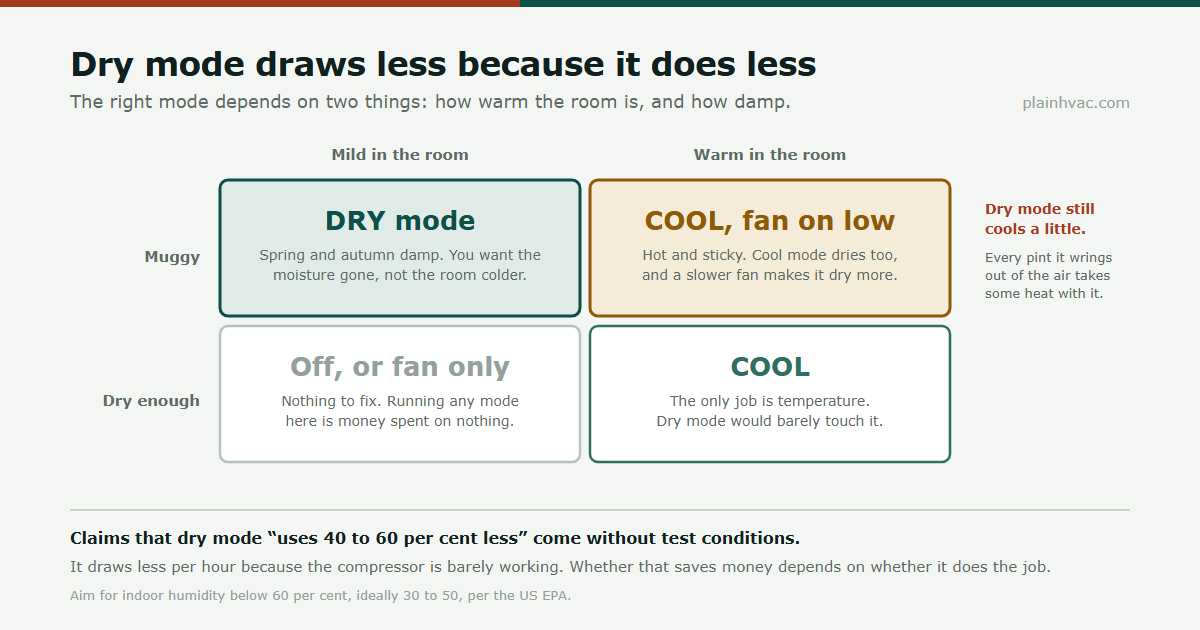
- Muggy and mild, like a damp spring or autumn day: dry mode. You want the water gone. Cool mode would reach the set temperature, stop, and leave the moisture behind.
- Muggy and hot: cool mode with the fan on low. Cool mode dries as well, and a slower fan lets it dry more.
- Dry and hot: cool mode. The only job is temperature, and dry mode would barely dent it.
- Dry and mild: off, or fan only. Nothing needs fixing, so any compressor mode spends money on nothing.
To tell muggy from dry, buy a cheap hygrometer rather than trusting how the room feels. The EPA recommends keeping indoor relative humidity below 60 percent, and ideally between 30 and 50 percent. Above 60, run dry or cool. Below 50, there is nothing worth removing.
Dry mode still cools the room
Every pint of water the coil wrings out of the air takes some of the room’s heat with it. Dry mode sends that heat outside, just like cool mode, only more slowly. So in a room that starts mild, a few hours of dry mode can leave it cooler than you wanted. That is the sign to switch it off, not a fault.
A dehumidifier works differently. Both halves of its refrigeration circuit sit in the same box, so the heat it pulls from the air comes straight back out the other side. The room ends up drier and slightly warmer. In a cool, damp basement that is exactly what you want, and a mini split in dry mode would only chill the space.
Cool air also holds less water to begin with. ENERGY STAR now rates portable dehumidifiers at 65 °F (18 °C) instead of the old 80 °F (27 °C), and the same machines now report smaller capacities, because there is less water to remove in cooler air. The same limit applies to a mini split drying a mild room. More on choosing a dehumidifier: whole-house or portable.
What the energy claims leave out
You will read that dry mode uses 40 to 60 percent less electricity than cool mode. The claim usually comes without test conditions: no unit, no room temperature, no humidity, and no word on what cool mode was doing in the comparison. Dry mode does draw less per hour, because the compressor is barely working. Whether that saves money depends on whether it does the job. If dry mode runs all afternoon in a hot, sticky room and the room stays sticky, the low draw bought you nothing.
And if the room stays clammy in cool mode as well, the unit itself may be the problem. An oversized system reaches the set temperature and stops before the coil has pulled much water out. That pattern, and the free fan setting to check first: why a house stays humid with the AC on.
Two side effects worth knowing
- More water down the drain. Dry mode exists to make condensate, so a part-blocked drain shows up there first. If the unit drips indoors, read where the water comes from: a mini split leaking water inside.
- A wet coil when it stops. Switching off straight after dry or cool mode leaves the coil and the blower wheel damp, and that is how a musty smell starts. Running the fan for a while afterwards helps, as does the unit’s coil-drying function if it has one: why a mini split smells musty.
Where this advice stops
This page covers choosing a mode on a working system. If the room stays above 60 percent humidity whatever mode you choose, or the unit drips, ices up or smells, the mode is not the problem. A technician should look at the system itself. Mini split dry mode is a useful tool for damp, mild days. It is not a fix for a unit that cannot keep a house dry.
If you have measured your own unit in both modes, with a plug-in meter or the unit’s app, post the readings in the comments along with the room temperature and humidity. Numbers with their conditions attached are exactly what the 40 to 60 percent claim is missing.