
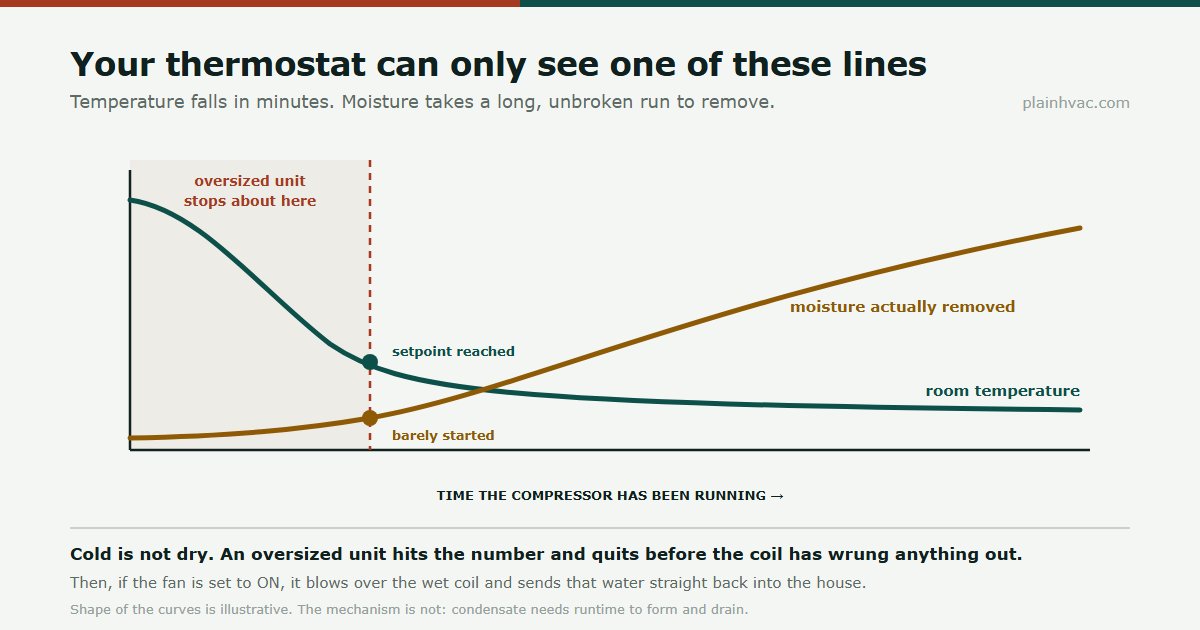
A house that stays humid with the AC running is usually cooling too fast, not too little. Your air conditioner removes moisture only while the coil sits cold and wet, and that takes a long unbroken run. An oversized unit hits the thermostat setting in a few minutes and shuts off, leaving the temperature correct and the moisture untouched. Cold is not the same as dry, and the thermostat cannot tell the difference.
How an air conditioner actually dries the air
Warm humid air passes over a coil colder than its dew point, water condenses on the fins like it does on a glass of iced drink, and that water drains away. Cooling and drying are two separate jobs done by the same part, and they run on different clocks.
Temperature drops within minutes. Moisture removal ramps up slowly, because the coil first has to get properly cold, then stay cold long enough for water to form and run off. Cut the cycle short and you complete the first job while barely starting the second.
Your thermostat measures only temperature. It satisfies, it stops the compressor, and by its own reckoning everything worked. Meanwhile The EPA puts the target for indoor relative humidity below 60 per cent, ideally between 30 and 50, and you may be sitting well above that while the room reads a perfect 72 °F (22 °C).
The free fix almost nobody mentions: check your fan setting
Look at your thermostat. If the fan is set to ON rather than AUTO, change it to AUTO today and see what happens over the next few days.
Here is why it matters. When the compressor stops, the coil is dripping wet and that water needs a few minutes to drain into the pan. On the ON setting the blower keeps running over the wet coil, re-evaporating the water it just worked to remove and delivering it straight back into your rooms. You paid to pull that moisture out and then paid again to push it back in.
AUTO stops the blower with the compressor, so the water drains away instead. It costs nothing, takes ten seconds, and on a house that stays humid with the AC running it is the single highest-return thing to try first.
Measure it before you spend anything on it
“Humid” is a feeling, and feelings do not survive a conversation with a contractor. A hygrometer costs very little and turns the complaint into something you can act on and check afterwards.
- Put it where you live — the room that bothers you, at about chest height, away from a vent, a window and a bathroom door.
- Read it at the moments that matter: late afternoon, overnight, and immediately after the system has been running a long cycle. One reading tells you almost nothing; a week of readings tells you the shape of the problem.
- Write the temperature next to every humidity reading. This is the part people skip, and it is the part that makes the numbers usable.
The reason temperature has to come along is that relative humidity is relative. It describes how close the air is to saturation at its current temperature, and cool air saturates sooner than warm air. The same quantity of moisture reads as a higher percentage in a cool room than in a warm one. So 60 per cent in a bedroom at 20 °C and 60 per cent in a living room at 24 °C are not the same air, and comparing rooms by relative humidity alone will mislead you.
If you want one number that does not move around like that, the dew point is it: the temperature at which the air would start condensing, which stays put as the air is heated or cooled. Many hygrometers display it, and several free calculators will work it out from temperature and relative humidity. A dew point that is roughly the same everywhere in the house, while the relative humidity readings differ, tells you that you have one moisture problem and several temperatures — which is usually the truth.
One practical check that needs nothing at all: look at the condensate drain while the system is running on a humid day. A system that is dehumidifying produces water, steadily and visibly. A system that runs for ten minutes at a time and produces almost none is describing its own problem.
Why oversizing is the usual root cause
An air conditioner sized generously for the hottest afternoon of the year is oversized for the other ninety per cent of the season. It satisfies the thermostat quickly, shuts down, sits idle, and starts again, never running the long steady cycles that dehumidify.
That is an uncomfortable conclusion, because it means the problem was built in on the day of installation by whoever specified the equipment. It is also why the usual advice, running it colder or longer, does not work: setting a lower temperature just produces more short cycles rather than longer ones.
Nobody selling and fitting air conditioners has much incentive to lead with this, which is why you will more often be offered a bigger unit than a smaller one.
Where the moisture is actually coming from
Removing moisture is half the equation. The other half is how much is arriving, and it is worth knowing which of these applies before buying equipment to fight it.
From outside. On a humid day, every cubic metre of outdoor air that leaks into the house brings its moisture with it, and in cooling season the air conditioner has to take it out again. A leaky house in a humid climate is a dehumidifier running with the door open. This is also why the leakiest parts matter disproportionately: a return duct in a damp crawlspace is not a small leak, it is a pipe deliberately connecting the system to the dampest air available.
From the ground. A crawlspace with a bare earth floor, or an unsealed basement, releases moisture continuously, and the house above it is the only route out. This is one of the largest sources in the housing stock it affects, it is invisible, and it is not solved by anything happening at the thermostat. A ground vapour barrier is the usual first move and is often transformative.
From the household. Cooking, showering, laundry dried indoors, a tumble dryer vented into the house rather than outdoors, a large aquarium, many houseplants, and simply the number of people breathing in the building. None is a fault; together they add up, and two of them have cheap fixes — a bathroom extractor that actually discharges outdoors and runs long enough after a shower, and a kitchen hood that vents rather than recirculates.
From a fault. A plumbing leak, a blocked condensate drain, a roof or flashing leak, or water finding its way into a wall. Damp that is confined to one area, or that does not track the weather, deserves this explanation before any of the others.
A quick way to tell indoor sources from outdoor ones: compare a humid day with a dry one. If indoor humidity tracks the weather closely, the air is coming from outside and the answer is sealing. If it stays stubbornly high regardless, something inside or underneath the house is supplying it.
What helps when you are humid with the AC running, in order of cost
- Set the fan to AUTO. Free, immediate, described above.
- Check airflow. Restricted airflow makes the coil too cold in spots and the system prone to freezing rather than dehumidifying: what actually decides whether a filter chokes your system, and four tests for not enough return air.
- Stop the humid air getting in. In summer a leaky house pulls damp outdoor air in continuously, and you are effectively dehumidifying the outdoors: how to find air leaks without a blower door test.
- Seal the ducts, especially any running through a humid crawlspace or attic, where the return side pulls that air straight into the system: which ducts you can seal yourself.
- Slow the blower down. A technician can lower the fan speed in cooling, which makes the coil colder and wetter and improves moisture removal. Cheap, and often overlooked.
- Add a dehumidifier. Treating the symptom deliberately, which is a legitimate choice when the equipment is already in the ground: ENERGY STAR publishes separate capacity tables for the two types, and the pint numbers do not compare.
When to suspect something other than sizing
- Short cycling that started recently. Oversizing does not develop over time. A system that used to run long cycles and now does not has a fault, not a sizing problem.
- Water where it should not be. A blocked condensate drain means the water you removed is sitting in the pan or on the floor instead of leaving.
- A musty smell alongside the damp. That often points at the equipment rather than the room: where that smell usually comes from.
- Only one room is clammy. That is a distribution question rather than a capacity one.
What is yours to try and what is not
What this article covers: why a cool house can stay humid, and the fixes you can try yourself.
What it does not cover: changing blower speed taps, adjusting refrigerant charge, or replacing equipment, all of which need a technician.
Stop and call someone if you find standing water near electrical equipment, ice on the refrigerant lines or coil, or visible mould growth. Sustained high humidity grows mould, so treat persistent damp as a deadline rather than a nuisance.
Sizing arguments provoke strong opinions in the trade, and I have taken a side. If you commission cooling equipment and think the oversizing case is overstated for your climate, argue it in the comments. I will engage with it.