
An extended HVAC warranty is an insurance product sold at the least useful possible moment: while you are already signing for a five-figure installation and have no appetite left for reading terms. That timing is not an accident.
It is not a scam, and sometimes it is a reasonable purchase. But you cannot judge it without knowing what the manufacturer already covers, and almost nobody does — because the two things it covers are not the same thing.
Parts and labour are separate, and only one is covered
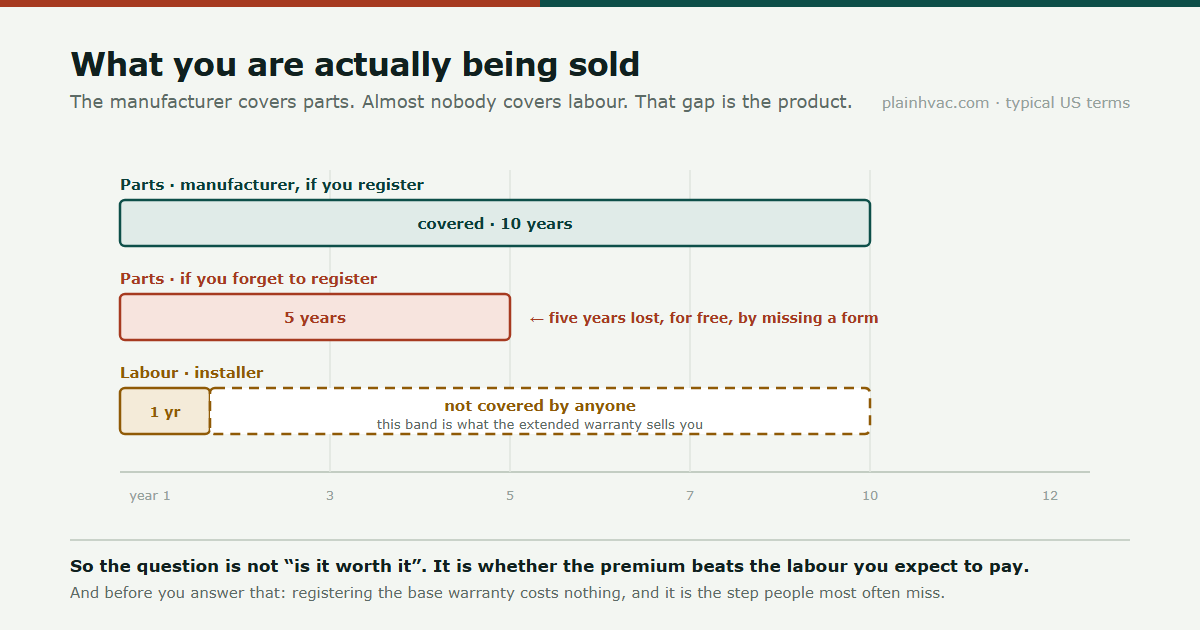
A manufacturer warranty covers parts. Typically ten years on the major components if you register the equipment, and commonly only five if you do not.
It does not cover labour. Your installer usually covers labour for one year, sometimes two. After that, a covered part still means an uncovered visit: diagnosis, removal, refitting, refrigerant recovery and recharge, and a return trip if the part has to be ordered.
This is the whole product. An extended HVAC warranty is labour insurance for years two to ten. Everything else it appears to cover, you already have.
That framing changes the question. It is not “is an extended warranty worth it”, which has no general answer. It is “does this premium beat the labour I expect to pay over that period”, which is arithmetic you can actually do.
The free step people skip
Before evaluating any paid plan: register the equipment. Manufacturers commonly require registration within 60 or 90 days of installation, and the penalty for missing it is losing half the parts coverage — ten years down to five.
Installers are supposed to do this and often do. Often is not always, and the failure is silent. You find out in year seven, when it matters.
- Find the model and serial number on the outdoor unit and the indoor unit. Photograph both plates.
- Check the manufacturer’s registration page for your equipment and confirm it is on file.
- If it is not and you are inside the window, do it now. It takes ten minutes and it is free.
- If you are outside the window, call the installer. Some will register retroactively if the lapse was theirs.
- Save the confirmation somewhere you will find it in eight years.
This single step is worth more than most extended warranties cost, and it is the one thing on this page that is unambiguously worth doing for every reader.
What the plan usually does not cover
Read the exclusions before the coverage. The recurring ones:
| Commonly excluded | Why it matters |
|---|---|
| Refrigerant | On a leak or compressor job this can be a large share of the bill |
| Diagnostic and trip charges | You may pay to find out that the repair is covered |
| Anything the installer did wrong | Installation faults are the most common cause of early failure |
| Damage from lack of maintenance | And the burden of proving maintenance is yours |
| Ductwork, thermostats, accessories | The bits outside the box are usually outside the plan |
| Claims where records are missing | See below |
The maintenance condition is the one that voids real claims. Most plans require documented annual servicing. If you skipped a year, or had it done by someone who left no paperwork, the claim can be refused after you have paid premiums for eight years.
Doing the arithmetic on an extended HVAC warranty
You need four numbers, and three of them are on paperwork you already have.
- The premium. Often in the region of a few hundred to twelve hundred dollars for a ten-year term on a full system.
- The local labour rate, and the typical hours for the two jobs that actually matter: a compressor replacement and a coil replacement.
- Your equipment’s realistic failure probability over the term. Nobody can give you this precisely, which is exactly why the seller does not want you thinking about it.
- The excess and the exclusions, from the actual contract rather than the sales sheet. In the United States, what a written warranty must disclose is governed by federal law — the FTC guide to it is readable and tells you what the seller is obliged to put in writing.
Then compare. If a compressor job is the scenario that justifies the plan, and that job costs meaningfully more than the premium, the plan is a reasonable hedge for someone who could not absorb the bill. If the premium is close to the cost of the repair you are insuring against, you are buying very little.
Worth noting: the same money in a savings account covers any repair, including the excluded ones, and you keep it if nothing breaks.
When it is a reasonable buy
- You could not comfortably absorb a sudden four-figure repair. This is the honest case for insurance, and it is a real one.
- The plan is backed by the manufacturer rather than a third party, and is transferable if you sell.
- Your equipment is a model with a known problematic component and you have checked that this is not excluded.
- Labour rates where you live are high relative to the premium.
When it is not
- You have not registered the base warranty. Do the free thing before the paid thing.
- The system is already old. Coverage on equipment near the end of its life buys you a repair on something you are about to replace.
- You cannot commit to documented annual maintenance, because the plan will likely not pay.
- The plan is sold by a third party you have never heard of. A warranty is only as good as the company still existing in year eight.
- You are being asked to decide today, at the point of sale. A plan that is genuinely good value will still be available next week.
That last one is the practical test. Time pressure on an insurance decision is a sales technique, not a feature of the product.
The cheaper things to do instead
Most early HVAC failures come from installation and from neglect, not from bad components. Money spent on prevention beats money spent on coverage.
- Register the warranty. Free.
- Change filters and keep the coils clean. The indoor side is a job you can do — the same principle as cleaning a blower wheel rather than paying for it.
- Have the installation checked if the system has never performed as promised. A commissioning fault caught in year one is cheaper than a compressor in year six.
- Fix the things that make the equipment work harder. Duct leakage and building leakage shorten equipment life; finding those leaks costs nothing but a Saturday.
Frequently asked questions
Is the manufacturer plan better than a third-party one?
Usually, on two counts: the manufacturer will still exist in year eight, and its plan is more likely to be honoured without argument by any dealer of that brand.
Does an extended warranty transfer if I sell the house?
Some do, often for a fee and within a time limit. Check, because it is one of the few features that has resale value.
My installer says the warranty is void without their annual plan.
Manufacturers require maintenance, not maintenance by that company. Documented work by any qualified technician normally satisfies the term. Read the actual warranty document before accepting that claim.
What if the part fails but the labour is not covered?
You pay the labour. That is the ordinary situation from year two onward and it is precisely the gap the extended plan is sold to fill.
I am outside the United States.
The structure is similar but the consumer protection is not. Several countries give statutory rights against the seller that run for years and cost nothing, which changes the calculation substantially. Check what you already have before buying more.
What actually shortens equipment life
A warranty pays for the failure. These three cause it, and all of them cost less to prevent than to claim for: short cycling wears a compressor on every start, a starved return makes equipment trip its own safeties, and a filter with no headroom left makes the blower work until it quits.
Warranty terms shift by brand and by year, and dealers see the claim outcomes that homeowners never do. If your experience with these contracts contradicts anything here, say so below.
Scope note. Coverage periods, registration windows and exclusions described here are common patterns in the United States, not universal terms. Your own warranty document and plan contract are the authority and they differ meaningfully between manufacturers and administrators. This is not financial or legal advice; if a claim has been refused and you believe wrongly, that is a question for your consumer protection authority — in the US, the FTC consumer site — rather than a website like this one.