
Short answer: repeated brief starts and stops deserve attention, but a fan pause, a defrost event and a compressor shutdown are not the same thing. Start by recording what actually stops, the controller setting and whether the room reaches its target. These five checks help you describe the problem without opening equipment.
Updated 1 October 2026. Source-based homeowner observation guide; not a diagnosis or a repair procedure.
Before the checklist: when to stop
If you notice a burning smell, smoke, repeated breaker trips or severe mechanical noise, stop using the system and arrange qualified help. Do not keep resetting a breaker or repeatedly restart equipment to reproduce a fault. For smoke or fire, leave the area and contact emergency services. Keep covers closed: this guide does not involve live electrical parts, capacitors or refrigerant.
Three different events all get called “short cycling”
The phrase is used loosely, and the three things people apply it to have very little to do with each other. Working out which one you are actually watching is most of the job, and it costs nothing.
The indoor fan starting and stopping. On many systems the indoor fan is allowed to stop between calls for heat, or to pause while the outdoor unit settles. A fan that goes quiet for a minute and comes back is not evidence that the compressor did anything. If the only thing you can hear is indoors, you cannot yet say what stopped.
A defrost cycle. In cool, damp weather a heat pump periodically reverses to melt frost off the outdoor coil. While it does, the indoor supply air turns cool, the outdoor fan usually stops, and the outdoor unit may steam. It looks alarming and it is routine. The tell is the weather: defrost clusters around damp conditions near freezing, and it should end on its own with normal heating resuming.
The compressor starting and stopping repeatedly within a few minutes. This is the one worth attention. The compressor is the part that costs money, and starting it is the hardest thing it does — a motor drawing its highest current against a pressure difference. A compressor that runs for three minutes and rests for three, hour after hour, is accumulating wear it would not accumulate in longer cycles, and in cooling it is also failing to dehumidify, because moisture only comes off a coil that has been cold for a while.
From inside the house, the three can be hard to tell apart. Outdoors they sound different, and the outdoor unit noise guide describes what each one sounds like. If you can safely stand near the outdoor unit for one cycle and write down what you hear, the log below becomes far more useful.
1. Record the pattern without changing settings
Note start and stop times from a safe location, along with the thermostat mode, setpoint, room temperature and any displayed fault. If you cannot tell whether the compressor or only a fan stopped, write “unknown.” A controller’s demand indicator is useful context but is not proof of compressor operation.
| Time | Room / target temperature | What changed? | Display or other observation |
|---|---|---|---|
| First start | _____ / _____ | Indoor fan / outdoor fan / unknown | Mode: _____ |
| First stop | _____ / _____ | _____ | Fault code: _____ |
| Next start | _____ / _____ | _____ | Outdoor conditions: _____ |
There is no single cycle duration that diagnoses every system. Variable-capacity equipment, weather and building load affect behavior. Repeated interruptions that prevent comfort, especially if new, give a technician a clearer concern than a guessed “normal” number of starts per hour.
2. Check whether the behavior matches defrost
Carrier’s heating troubleshooting guide explains that temporary changes during defrost can be normal. Look for the description in your own manual and note whether normal heating resumes. Persistent ice or failure to recover needs service.
Do not diagnose a failed defrost control from an arbitrary interval alone. Record the conditions and symptoms. If your main concern is air temperature rather than repeated stops, read the cool-air guide.
3. Inspect user-serviceable filters and visible airflow paths
Follow the owner’s manual to inspect or clean only the filter intended for user maintenance. Note blocked indoor grilles or furniture obstructing them. From outside the cabinet, look for obvious debris around the outdoor unit. Do not reach through a fan grille, chip ice off a coil or remove service panels.
Carrier’s maintenance guidance identifies maintenance and airflow as relevant to heat-pump performance. Finding a dirty filter does not prove it was the only cause. If the behavior continues after permitted maintenance, keep the observation log for the service visit. See also filter selection and airflow.
4. Note the thermostat’s surroundings and schedule
Check whether a schedule changed the target at the time of the stop. Note direct sunlight, a nearby heat source or supply air reaching the sensor. Record the setting before changing anything. Do not move the thermostat, alter wiring or change installer-only cycling controls as an experiment. Our thermostat placement guide explains the observation in more detail.
5. Look at what surrounds the outdoor unit
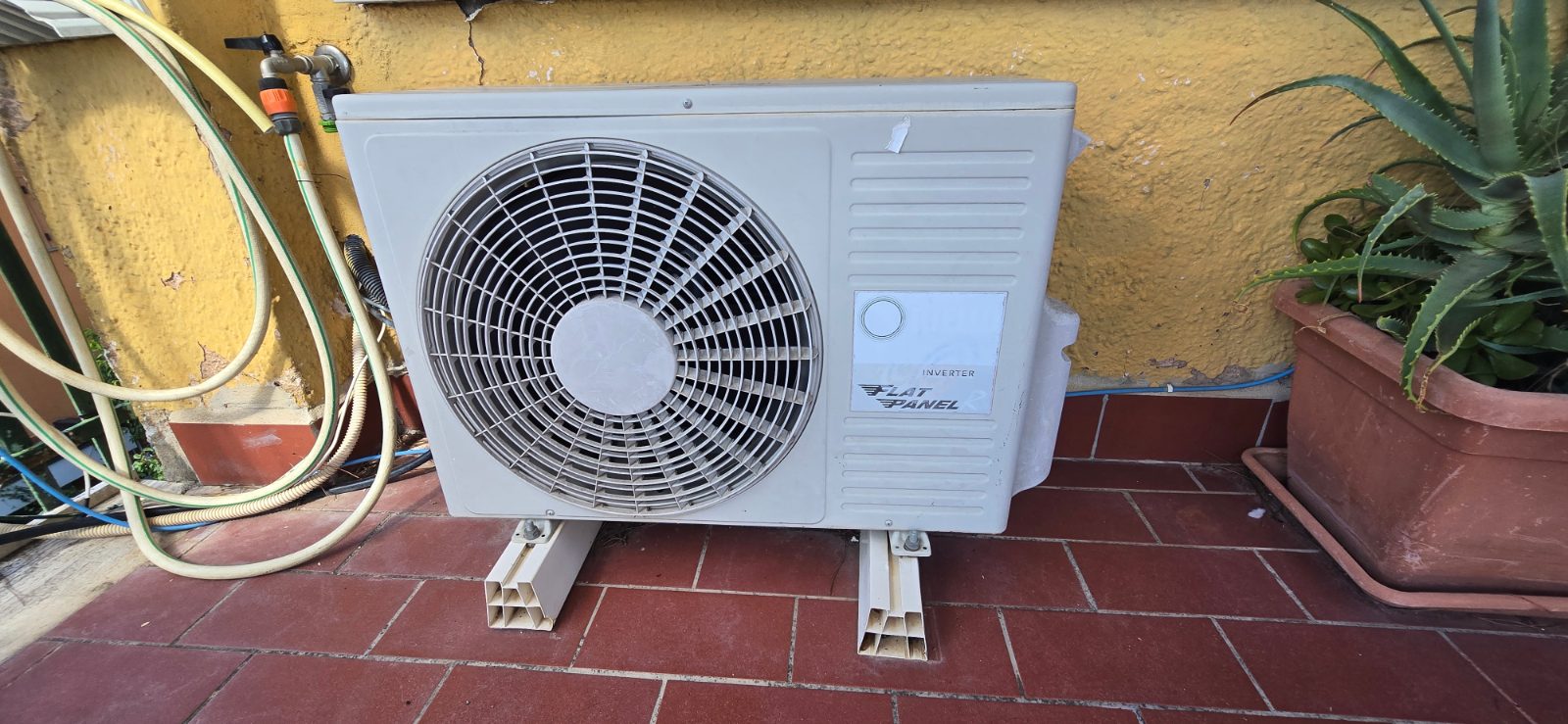
An outdoor unit works by moving a large volume of air across its coil and throwing it away from itself. If that air cannot leave, or if what leaves comes straight back in, the unit ends up breathing its own exhaust. In heating that makes the coil colder than it should be and brings on frost sooner; in cooling it raises the pressure the compressor works against. Either way the equipment can reach a protective limit and stop, restarting once pressures settle — which from indoors looks exactly like short cycling with no obvious cause.
This is worth a minute of your time because it is the one contributing cause a homeowner can see without opening anything. Walk around the unit and note, in writing:
- How much open space there is in front of the fan discharge, and whether anything — a wall, a fence, a parked car, a hedge — is close enough to bounce the air back.
- How close the sides and back are to a wall. The coil draws air in through them, and a flank pressed against render is a flank that cannot breathe.
- What is growing or stored nearby. Leaves, seed heads, grass clippings and pet hair all end up in the coil fins, and a plant in a pot beside the unit is a steady supply of all four.
- Whether the unit sits in its own pocket of still air — a narrow side passage, a recessed balcony, a courtyard — where discharged air has nowhere to go.
- Whether anything drips or sprays onto it, including a hose, a gutter, or an air conditioner above it.
- How it is supported. Floor feet, wall brackets and a concrete pad all work; what matters is that it is level, stable, clear of standing water and raised enough that drainage and, in cold climates, snow are not a problem.
In the photograph above, the things worth writing down are the clearance on the right-hand flank, which is close to the wall, and the plant and hoses beside the cabinet. Neither proves a fault. Both are the kind of detail a technician would otherwise discover on arrival, and both are cheap to improve if they turn out to matter.
What the clearances actually need to be is not something a website can tell you: the figures come from the installation manual for your specific model, and manufacturers differ, with separate minimums for the discharge face, the inlet faces and the space above. Find your model number on the data plate, find the manual, and compare. Clearing debris from around a unit and cutting back a plant are both things you may safely do with the power off; reaching through the fan grille, washing out a coil or straightening fins are not, and belong to a technician.
Why a compressor stops early: the mechanisms worth knowing
Your log is more useful if you know what it might be pointing at. These are the usual routes to a compressor that will not stay running, written as mechanisms rather than as a diagnosis of your system.
The thermostat is satisfied too quickly. If the equipment has more capacity than the building needs at the moment, it hits the setpoint in a few minutes and shuts off. That is oversizing, and it is the most common cause of frequent cycling in a system that is otherwise healthy and in no particular distress. It shows up as short runs with long rests, comfortable temperatures, and bigger swings between them.
Airflow across the indoor coil is restricted. A blocked filter, closed registers, crushed flexible duct or an undersized return starves the coil. In cooling the coil gets too cold and can ice; in heating it gets too hot. Either can reach a limit that stops the compressor. This one tends to come with weak airflow at the registers and a system that struggles in the extremes rather than in mild weather. See filter selection and airflow and not enough return air.
Heat cannot leave or enter the outdoor coil. The recirculation and debris problems described in check 5, plus a coil that is matted with dirt. Typically worst in the hottest or coldest weather, when the unit has the least margin.
Refrigerant charge or a pressure fault. Too little refrigerant, a restriction, or a failing pressure switch will trip the compressor off and let it back on. You cannot see or test this, and nobody can from a description. It is the clearest reason to stop at observation and call someone with gauges.
Controls and electrical. A thermostat reading a temperature the house does not share, a schedule changing the setpoint at the moment you noticed, a loose connection, a failing contactor or capacitor, or a short-cycle protection timer doing exactly what it was designed to do. The last one is why a system sometimes refuses to restart for several minutes after a power interruption: that is a feature, not a fault.
What the technician should investigate
Possible causes include airflow restrictions, control or electrical faults, refrigerant problems and a mismatch between equipment capacity and the load. These are possibilities, not diagnoses. Carrier’s cooling-mode short-cycling guide discusses several of these causes; that does not make every cooling-system symptom a universal heat-pump fault.
Oversizing can contribute to frequent cycling, but frequent cycling alone does not prove that the equipment needs replacement. Ask what measurements support the diagnosis and whether controls, airflow and operating conditions were assessed.
Make the service call more useful
- Give the indoor and outdoor model numbers, if available without opening a cabinet.
- Share the log, fault code and when the pattern first appeared.
- State whether comfort is affected and whether this occurs in heating, cooling or both.
- Mention recent filter, thermostat, maintenance or installation changes.
- Ask for the diagnosed cause, supporting checks and a written repair scope before authorizing replacement.
Editorial scope: this checklist organizes safe observations. No installation was tested for this article, and the illustration is not evidence of a field visit. Manufacturer sources are linked above. See our editorial standards or send a correction.