
Every guide tells you how to find air leaks with an incense stick, a dollar bill or a torch. The methods are real. What almost none of them mention is that on a still day they barely work at all.
A leak only reveals itself when air is moving through it, and air only moves when there is a pressure difference. On a calm afternoon with the heating off, the pressure across your walls is close to nothing, and incense at a window will sit there doing very little. That is not proof the window is sealed. It is proof you have not created a reason for the air to move.
First, look in the right places
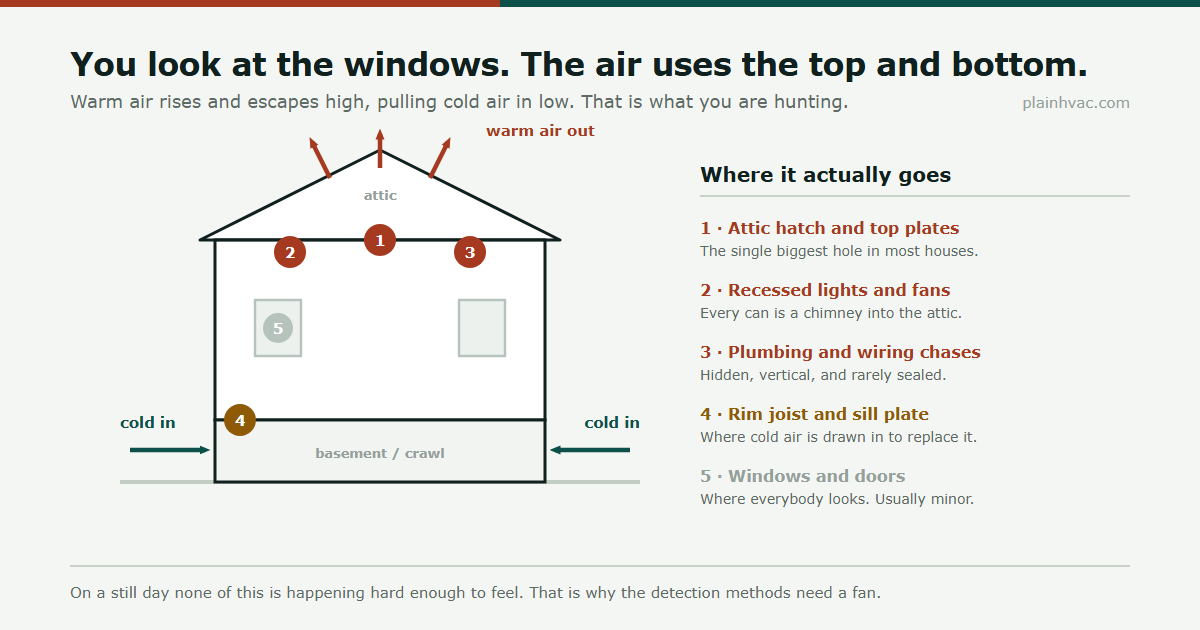
Before any technique, correct the target. People hunt around windows and doors because those are the joints they can see. The physics does not care what you can see.
Warm air is buoyant. It rises, escapes through whatever openings exist near the top of the house, and that outflow pulls replacement air in near the bottom. The result is that the big leaks are usually at the very top and the very bottom of the building — the attic hatch, the top plates of interior walls, recessed light housings, plumbing and wiring chases, and down at the rim joist where the frame meets the foundation.
Windows matter, and sealing them is worth doing. They are just rarely where most of the air is going.
The fan that makes every other method work
This is the step that turns guessing into finding, and it costs nothing if you own a box fan.
- Close every exterior window and door, and open every interior one so the whole house is one connected volume.
- Put a box fan in an exterior doorway facing outward, so it blows air out of the house.
- Block the gap around the fan with cardboard, a towel or plastic sheet. It does not need to be perfect.
- Run the fan on high. The house is now at negative pressure, and outside air is being pulled in through every leak you have.
- Now walk the house with your incense stick. The smoke will be visibly dragged towards leaks that gave you nothing five minutes earlier.
This is a crude version of what a blower door does. It will not give you a number, but for the purpose of locating leaks it finds most of what matters.
Stop. Read this before you switch the fan on.
Turn off every combustion appliance first. Furnace, boiler, gas water heater, gas fireplace, wood stove. Not down — off.
Depressurising a house can reverse the draught in a flue and pull combustion gases back down into the living space instead of letting them go up the chimney. That includes carbon monoxide, which you cannot smell and which the EPA describes the effects of here.
This is the part the cheerful listicles leave out. It is a genuine hazard, it is entirely avoidable, and it is the reason this test belongs on a cool day when nothing needs to be burning anyway. If you have a working carbon monoxide alarm, and you should, leave it powered while you do this.
What each method actually finds
| Method | Finds | Misses |
|---|---|---|
| Incense or smoke pencil, with the fan running | Almost everything you can reach | Leaks inside wall cavities and above ceilings |
| Hand, with the fan running | Larger gaps, fast | Anything subtle. Skin is a poor instrument |
| Dollar bill in the sash | Worn window and door seals | Everything that is not a window or a door |
| Torch at night, someone outside | Straight-through gaps big enough to see | Convoluted paths, which is most of them |
| Infrared thermometer | Cold surfaces, if there is a temperature difference | Confuses missing insulation with air leakage |
| Soapy water | Precise location on a specific joint | Useless as a search method. Use it to confirm |
Two of those deserve a note. The infrared thermometer is the one people over-trust: a cold patch tells you heat is being lost there, but it does not tell you whether that is a hole or simply a gap in the insulation, and the fix is different. And soapy water is a confirmation tool, not a search tool — you have to already suspect the spot.
Seal in the order the air uses
Having found them, the order matters more than people expect. Sealing the bottom of the house first can make the top worse, because you have restricted the inlet without touching the outlet.
- Top first. Attic hatch, top plates, recessed light housings, chases. This is where the driving force originates.
- Bottom second. Rim joist, sill plate, penetrations through the foundation wall.
- Middle last. Windows, doors, outlets on exterior walls. Cheap, satisfying, and the smallest share of the total. Note that ducted systems have their own leakage problem, separate from the building envelope — a badly zoned duct system can push conditioned air out through the fabric faster than any window ever will.
Sealing is also the cheapest way to make an undersized system cope. If one room never gets comfortable, it is worth spending a weekend on air sealing before spending on equipment — and if it still does not, then a dedicated head for that room is a better answer than fighting the ducted system.
The general principle and the material choices are covered well by the ENERGY STAR seal and insulate guidance, which is worth reading before you buy anything.
When you actually want the real test
- You need a number, for a grant, a rebate, a code compliance check or a before-and-after comparison. The fan trick gives you locations, never a figure.
- You have sealed everything you can find and it is still draughty. That means the remaining leaks are in places you cannot reach, and a blower door with an infrared camera will find them.
- You are about to spend serious money on insulation. Knowing the leakage rate first changes what is worth doing, and it also changes the heating load your equipment has to meet — which feeds straight into settings like the dual fuel switchover point.
- The house has combustion appliances and you are planning heavy sealing. Tightening a house can create a ventilation problem, and that is a measurement question, not a guess.
That last one is worth taking seriously. A house can be sealed to the point where it no longer supplies enough air for its own appliances or its occupants.
Frequently asked questions
What is the best day to do this?
A cold, still day gives the strongest natural stack effect, but the fan matters more than the weather. Avoid a windy day — gusts make the smoke move for reasons unrelated to your leaks.
Can I use a window fan instead of a box fan in the door?
Yes, as long as it blows outward and you block the rest of the opening. Volume matters more than placement; a bigger fan gives a clearer result.
Does this work in summer?
For finding leaks, yes — the fan supplies the pressure difference, not the weather. Natural stack effect is much weaker in mild weather, which is exactly why the fan is doing the work.
My infrared thermometer shows a cold spot with no draught.
That is usually missing or compressed insulation rather than an air leak. Both waste heat, and both are worth fixing, but with different materials.
How much of my heating bill is air leakage?
It varies far too much between houses for any published percentage to be useful for yours. That is precisely what a blower door number tells you and this method cannot.
Once you know where the air goes
Sealing the house is half the job. The ducts inside it leak on their own account, and in summer the air you let in carries moisture with it: which ducts you can seal yourself, and why a cool house can still feel clammy.
Auditors who do this with a blower door will spot shortcuts in the manual methods above. If you are one and there is a test I should add or drop, tell me in the comments.
Scope note. Depressurising a house with combustion appliances running can backdraft flues and draw carbon monoxide indoors. Switch every combustion appliance off before you start, and keep a working CO alarm powered throughout. If you are unsure whether an appliance is off or what counts as one, do not run this test — have a professional audit instead. Sealing a house significantly can also reduce ventilation below what the occupants and appliances need; that is a measurement question for a professional, not a judgement call.