
For most basements a portable dehumidifier is enough, and the case for a whole house dehumidifier is narrower than the people selling one tend to admit. The decision does not turn on capacity. It turns on three physical facts about your house: where the damp actually is, whether a drain is within reach of the unit, and whether your ducts even serve the room with the problem. Get those three straight and the choice makes itself.
The number on the box cannot decide this for you
Start here, because almost every comparison you will read gets it wrong. In June 2019 the federal test procedure for dehumidifiers changed, and portable units are now rated at 65 °F (18 °C) instead of 80 °F (27 °C). Cooler air holds less moisture, so the same machine now claims a much smaller number.
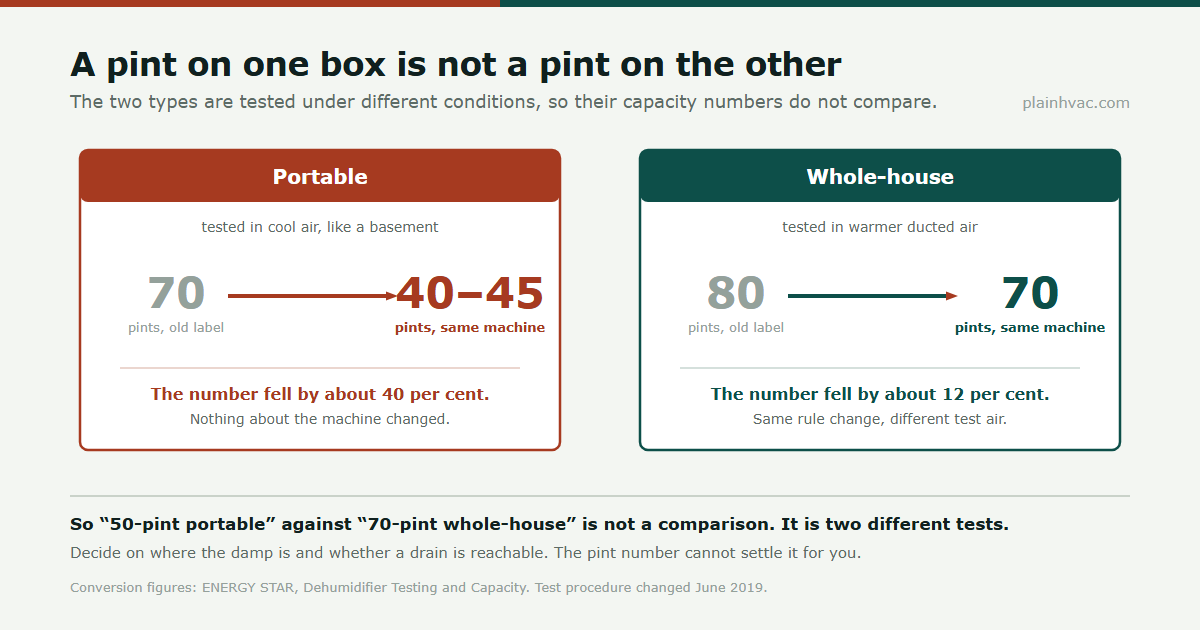
ENERGY STAR publishes the conversion tables. A portable that was sold as 70 pints per day is now labelled 40 to 45. A 50-pint portable is now a 30-pint. Nothing about the hardware changed.
Here is the part nobody points out. Whole-house units are tested in warmer ducted air, and the same rule change moved their numbers barely at all: 80 pints became 70, and 120 became 100. So a portable lost about 40 per cent of its printed capacity while a whole-house unit lost about 12 per cent.
The consequence is simple and it undermines most of the advice on this topic: when you compare a 50-pint portable against a 70-pint whole-house unit, you are not comparing two capacities. You are comparing two different tests. Any article that lines those numbers up in a table is telling you something untrue.
What a portable actually needs to work unattended
The bucket is the reason people give up on portables, not the capacity. A unit that needs emptying every day will get switched off within a fortnight. So the real question about a portable is drainage:
- Gravity drain. Most portables have a hose port. It only works if there is a floor drain, sump or sink below that port. Water does not run uphill, and the port sits partway up the cabinet, not at the floor.
- Condensate pump. If there is no drain below the port, you need a small pump to lift the water. Many basement installations need one, and it is the step people discover after buying.
- Low-temperature operation. A cold basement will frost the coil. Units intended for basements defrost automatically; cheaper ones stall and produce very little water. If the space runs below about 60 °F (16 °C), check this specifically before buying.
Solve drainage and a portable becomes an appliance you forget about. Ignore it and you have bought a bucket with a fan.
What a whole-house unit actually needs, including the catch
A ducted unit sits in a mechanical room, drains to a pump, and treats every room the ducts reach. Noise stops mattering because nobody sleeps next to it. Those are real advantages and they are not in dispute.
The catch is worth asking about before you sign anything. Some whole-house dehumidifiers are ducted into the return and dehumidify only while the air handler fan is running. Others are installed with their own dedicated supply and return and run independently on their own humidistat. These are very different products in practice, and a quote will not always make clear which one you are getting. Ask directly: does this run on its own, or only when the furnace fan runs?
The second question is whether the ducts go where the water is. A whole-house unit treats the air its ductwork touches. If the damp sits in a basement that the duct system barely serves, or in a crawlspace with no ducts at all, the expensive option is treating the wrong air. And if your ducts leak on the way there, you have a separate problem to fix first: which ducts you can seal yourself.
The three questions that decide it
- Is the damp in one place or several? One room, one basement, one crawlspace: portable. Several rooms across the house at once, on the floors your ducts serve: the whole-house case gets real.
- Is there a drain the unit can reach, or room for a pump? Both types need somewhere to put the water. This is the question that most often decides the installation, and almost nobody asks it first.
- Do your ducts actually serve the damp space? If the answer is no, a ducted unit cannot fix it whatever it cost. Uneven duct coverage is its own problem: why the bypass damper is not a fix.
When neither one is the answer
A dehumidifier removes moisture from air. It does not stop water arriving. If any of the following is true, spend the money there first, because otherwise you are buying a machine that runs permanently against a supply it can never beat:
- Bulk water. Ground sloping toward the house, gutters discharging at the foundation, a downspout that ends in a puddle. Fix the outside first. It is cheaper and it is permanent.
- Humid outdoor air being pulled in. In summer a leaky house drags damp air inside continuously, and you will be dehumidifying the outdoors. Finding those leaks costs nothing but an afternoon: how to find air leaks without a blower door test.
- Visible mould already growing. Drying the air does not remove what is there. The EPA puts the target at below 60 per cent relative humidity, ideally between 30 and 50 per cent, but existing growth is a cleanup job first.
- A musty smell with no visible damp. That is often the equipment rather than the room, and it has a specific and unglamorous cause: where that smell usually comes from.
What this does and does not cover
What this article covers: choosing between a portable and a ducted dehumidifier, and the drainage each one needs.
What it does not cover: installing a ducted unit, cutting into ductwork, wiring a dedicated circuit, or sizing equipment for a specific house.
Stop and call someone if you find standing water near electrical equipment, mould over a large area, or a crawlspace you would have to enter to reach the unit. A portable dehumidifier draws real current, so run it on its own outlet rather than an extension lead.
What it costs to run, which is the part people forget
A dehumidifier is one of the few appliances in a house that runs for months without stopping, and that steady draw matters more than the purchase price across a few seasons. Whatever you buy, look at the energy factor rather than the sticker, and remember that a unit running continuously in a losing fight against bulk water is the most expensive configuration available. The same logic that catches people out with always-on equipment applies here: why nobody agrees what standby power costs.
The pint arithmetic here comes from ENERGY STAR’s published tables rather than from field measurement. If you install these and see units behave differently from what the ratings imply, that is worth more than the tables. Post it.