
On a dual fuel system, the switchover temperature decides which appliance heats your house at any given moment. Set it wrong and you either burn gas on mild days when the compressor was cheaper, or run the compressor in weather where it costs more than the furnace.
Almost every installation is left on a default, commonly somewhere around 35 to 40 °F (2 to 4 °C). That number is a guess, and it is a guess about the wrong thing.
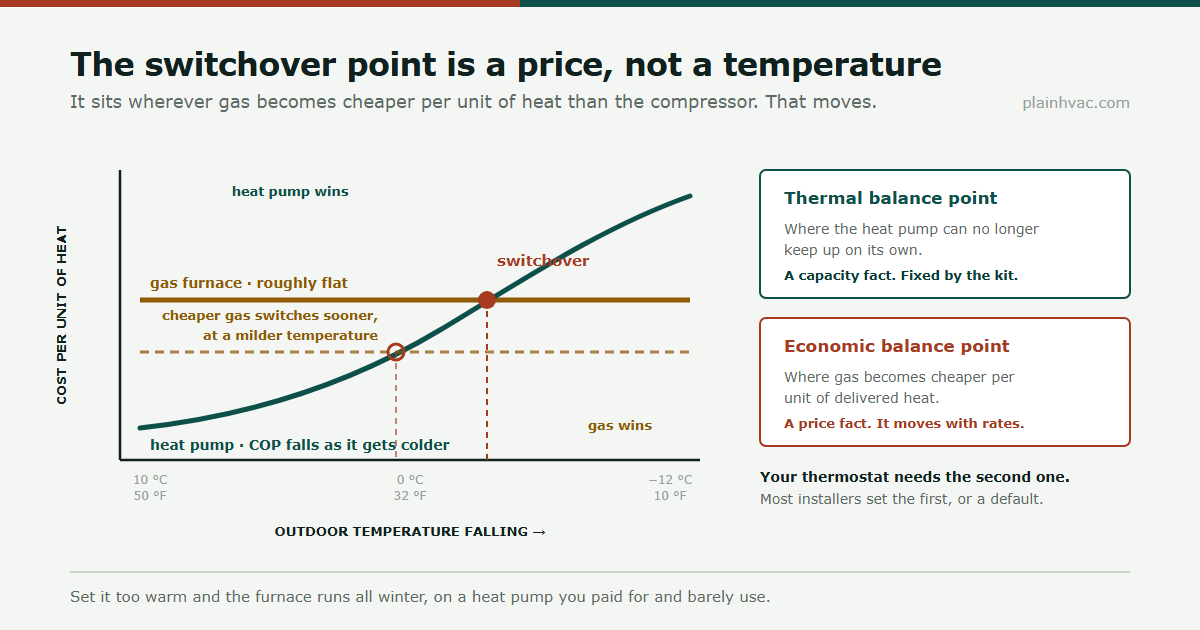
Two different temperatures, routinely confused
| What it is | What sets it | |
|---|---|---|
| Thermal balance point | The outdoor temperature below which the heat pump can no longer hold your setpoint on its own | Your equipment and your house. A capacity fact |
| Economic balance point | The outdoor temperature below which a unit of heat from gas costs less than a unit from the compressor | Your gas and electricity prices. A price fact |
These are not the same number and they are not even the same kind of number. The thermal one is fixed by physics and hardware. The economic one changes when your utility changes its rates, and it can move by ten degrees or more.
Your thermostat needs the economic one. The thermal balance point is a floor you must not go below, not the setting itself.
Why the default is usually set too warm
Installers tend to set the switchover high because the failure mode is invisible. A system that hands over to gas early always keeps the house warm, nobody complains, and no call-back is generated. A system that leans on the compressor too long in a cold snap produces a cold house and an angry phone call.
The result is predictable: on a lot of dual fuel installations the furnace does most of the winter’s work, and the heat pump — the expensive part that was supposed to save money — runs during a handful of mild weeks. The equipment is not underperforming. It is being switched off.
Working out your own number
You need three things: your gas price, your electricity price, and your unit’s performance data. The arithmetic is one line.
Compare the cost of the same amount of delivered heat. One therm of gas is 100,000 BTU; a furnace at 95 % efficiency delivers 95,000 of them. The same 100,000 BTU of heat is 29.3 kWh, and a heat pump running at a coefficient of performance of COP needs 29.3 ÷ COP kWh of electricity to deliver it.
Set those equal and you get the COP at which the two break even:
Break-even COP = 27.8 × (electricity price per kWh) ÷ (gas price per therm)
Above that COP the heat pump is cheaper; below it, gas is. Then look up your unit’s published performance table, find the outdoor temperature at which it produces that COP, and that is your switchover.
The break-even COP at common prices
| Electricity | Gas $1.00/therm | $1.50 | $2.00 | $2.50 |
|---|---|---|---|---|
| $0.12/kWh | 3.3 | 2.2 | 1.7 | 1.3 |
| $0.18/kWh | 5.0 | 3.3 | 2.5 | 2.0 |
| $0.24/kWh | 6.7 | 4.5 | 3.3 | 2.7 |
| $0.30/kWh | 8.4 | 5.6 | 4.2 | 3.3 |
Calculated from the formula above at 95 % furnace efficiency. Substitute your own rates from your bills; the EIA publishes regional averages if you want to sanity-check them.
Read that table carefully, because it contains an uncomfortable result. A residential air-source heat pump rarely exceeds a COP of about 4, and never in cold weather. Any cell above roughly 4 means the compressor never beats gas at those prices — not at any temperature.
If your rates land in that corner, the honest conclusion is that the heat pump should be locked out for heating entirely and used for cooling, and that dual fuel was not the right purchase. No installer is going to tell you that after the fact, and it is worth knowing before.
What moves the number after installation
- Rate changes. Both fuels, in both directions. A tariff change can move the switchover by ten degrees.
- Seasonal gas pricing. Where gas is dearer in winter, the number you calculated in October is wrong by January.
- Time-of-use electricity. If your rate varies through the day, so does the crossing point. Some thermostats can handle this; most cannot, so calculate on the rate that applies during your heating hours rather than the daily average.
- A new tariff on either supply. This is the one people never revisit.
Recalculating once a year, when the rates land, takes five minutes and is the single highest-value thermostat adjustment available on this kind of system.
The floor you must not cross
The economic answer can come out colder than your equipment can actually manage. If the arithmetic says 15 °F (−9 °C) but your heat pump cannot hold the house below 25 °F (−4 °C), the higher number wins. Comfort and the thermal balance point set a floor; economics only chooses within it.
If you do not know your thermal balance point, the symptom is simple: the house drifts below setpoint and the auxiliary heat runs continuously rather than intermittently.
When to leave it alone
- Your bills are already in line with what the system promised. If it is working, the calculation is confirmation, not a reason to change.
- You have a variable-capacity system with an integrated controller that manages the crossover itself using measured data. Some do this well.
- The house has comfort problems at the current setting. Fix those first; a colder switchover will make them worse.
Related settings worth checking at the same time: whether the system is zoned in a way that fights itself, and what the equipment draws when it is doing nothing at all, which is stranger than most people expect.
Frequently asked questions
Where do I change the switchover temperature?
On most dual fuel setups it is a thermostat setting, sometimes called balance point, changeover or compressor lockout. On others it is set at the outdoor unit or in an outdoor thermostat, and on a few it is fixed in the control board and needs an installer.
Is a lower switchover always better?
No. Lower is better only while the compressor is genuinely cheaper. Past the break-even COP you are paying more for the same heat, and past the thermal balance point you are also cold.
My thermostat only offers a few preset options.
Then choose the nearest one on the correct side. If your calculated point is 32 °F and the options are 30 and 35, take 35 in a cold climate and 30 in a mild one — you are trading a little cost against a little comfort risk.
Does this apply to a heat pump with electric backup?
No. With electric resistance backup the compressor is always cheaper than the strips, at any COP above 1. The lockout there is purely about capacity, not cost.
I am not in the United States.
The method transfers, the units do not. Convert both fuels to cost per kWh of delivered heat and compare directly; the break-even COP is then simply the gas price per delivered kWh divided by the electricity price per kWh.
The settings that sit next to this one
Switchover is one of three controls that decide what the system costs you, and installers leave all three on defaults: when auxiliary heat is allowed to run, and whether the thermostat reads the house at all.
Utility rates and heat pump performance curves both vary enough that the right switchover point in your area may sit well outside the ranges here. If you set these for a living, I would value your numbers.
Scope note. The formula assumes a 95 % efficient furnace and US units; adjust the efficiency figure for your own appliance. Performance data for your heat pump comes from the manufacturer’s extended ratings table, not from the nameplate. The thermal balance point and any minimum operating temperature in your manual take precedence over the economic calculation. Changing control wiring or outdoor sensors is licensed work in most jurisdictions.