
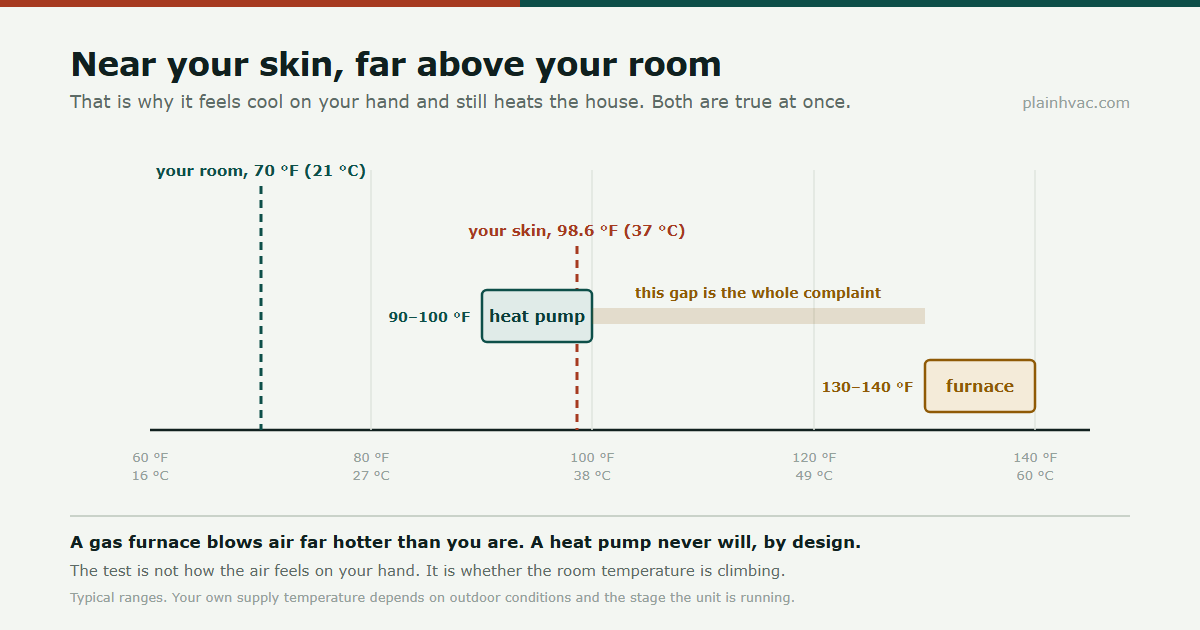
A heat pump blowing cool air is usually doing exactly what it was built to do. Its supply air sits somewhere around 90 to 100 °F (32 to 38 °C), which lands close to your skin temperature and therefore feels like nothing much on your hand. A gas furnace delivers 130 to 140 °F (54 to 60 °C), which feels obviously hot. People switching from one to the other reliably conclude the new system is broken. Usually it is not.
Why your hand is the wrong instrument
Your skin runs at about 98.6 °F (37 °C). Anything below that reads as cool, however warm it is in absolute terms. Heat pump supply air sits right around that line, so it registers as neutral or slightly chilly even while it pours heat into a 70 °F (21 °C) room.
The room is the thing that matters, and the room is 25 to 30 degrees colder than the air arriving. That gap is what heats your house. Your hand simply cannot perceive it, because your hand is calibrated against your own body rather than against the wall.
So replace the hand test with a thermometer test: is the room temperature climbing, and does the system eventually reach setpoint and shut off? If yes, nothing is wrong, whatever the vent feels like.
The five-minute check that settles it
- Note the indoor temperature and the setpoint. Leave it thirty minutes.
- Check again. Climbing, even slowly, means the system is heating.
- Watch for a shut-off. A system that reaches setpoint and stops is working correctly, full stop.
- Check whether the outdoor unit is running. A heat pump blowing cool air with a completely still outdoor unit is a different story, and that one is worth a call.
Measure the rise, not the supply temperature
A supply-air number on its own tells you very little, because it depends on what the system started with. The figure that carries information is the rise: the difference between the air going into the system and the air coming out of it. That subtraction removes the room temperature from the answer and leaves the equipment.
How to take it, with a cheap probe thermometer and no tools:
- Let the system run undisturbed for at least ten to fifteen minutes first. A reading taken in the first minutes of a cycle is a reading of a coil that has not settled.
- Take the return temperature at the return grille, in the airstream, not against the wall beside it.
- Take the supply temperature at a register, with the probe in the moving air rather than touching metal. Choose a register near the equipment for the cleanest number, and a distant one if what you are investigating is loss along the way.
- Subtract. Write down both numbers, the time, the outdoor temperature and whether any backup heat was on.
A heat pump in heating typically produces a modest rise — considerably smaller than a furnace, which is the whole reason the air feels disappointing. The exact figure that is right for your equipment belongs to its own documentation, and it moves with outdoor conditions, so there is no single number to memorise. What you are looking for is not a target but a pattern: the same measurement repeated across different outdoor temperatures, which is something no technician arriving for an hour can produce and you can.
One trap worth naming. If auxiliary or emergency heat is running, the supply temperature will be much higher and the test tells you nothing about the heat pump. Check what the thermostat says it is doing before you trust a flattering number.
Why the air gets cooler as the weather does
There is a second reason this complaint arrives in January rather than October, and it is not a fault. A heat pump gathers heat from outdoor air. The colder that air, the less heat there is in it to gather, so the capacity of the machine falls at precisely the moment the house is losing the most. Supply temperature falls with it.
Somewhere on the way down is the temperature at which the heat the system can deliver and the heat the building is losing become equal — its balance point. Above it, the heat pump reaches setpoint and shuts off. Below it, it cannot, and it will run continuously, delivering air that feels cooler than it did a month ago while the room holds steady or slips slowly behind. That is a system at its limit, not a system that has broken, and the difference matters because one of them is fixed by a technician and the other by supplementary heat, insulation or different expectations.
This is why the two observations recommended further down — outdoor temperature, and whether the room holds — are worth more than any single vent reading. A system that falls behind only below a certain outdoor temperature is behaving like a correctly sized heat pump. A system that falls behind at mild temperatures is not, and that is a real finding.
The one time cool air is normal and alarming at once
Heat pumps run a defrost cycle in cold damp weather to clear ice off the outdoor coil. During defrost the system briefly reverses, so for a few minutes it genuinely blows cool air indoors, and the outdoor unit may steam dramatically enough that neighbours ring the doorbell.
Defrost is normal and it ends. What is not normal is defrost running constantly, or ice that never clears. If you also hear a noise that arrived recently, read that clue first: what outdoor unit noises actually mean.
What a defrost cycle actually looks like
Since defrost is the most common explanation for alarming cool air, it is worth being able to recognise one with confidence rather than guessing. A defrost in progress has a recognisable signature:
- It begins with a distinct clunk or whoosh as the reversing valve shifts. If you are standing outside, it is unmistakable.
- The outdoor fan stops, while the compressor keeps running. An outdoor unit that is humming with a still fan, in cold damp weather, is almost certainly defrosting.
- Steam rises off the outdoor coil as the ice melts and water runs off it. This is the part that gets the fire brigade called, and it is just water.
- Indoors, the supply air turns cool, because the system is temporarily taking heat from the house to melt the ice. Most equipment brings on backup heat during defrost to soften this; some does not.
- It ends with another valve shift, the outdoor fan restarts, and normal heating resumes within a few minutes.
The whole event is short, measured in minutes rather than tens of minutes. What is worth recording is how often it happens and whether it finishes the job. Occasional defrosts in cold damp weather are the system working. Defrosts that come one after another, a coil that is still carrying ice after the cycle ends, ice building on the top of the cabinet or on the fan guard, or a unit encased rather than frosted, are all worth a call — and worth noting with the outdoor temperature and humidity, because a defrost pattern that makes sense at 2 °C and fog makes no sense at −10 °C and dry air.
Clearing snow away from around the unit and keeping its drainage path open are things you may safely do. Chipping ice off a coil, pouring hot water over it, or reaching through the fan guard are not: the fins bend if you look at them, and the circuits inside stay live.
When cool air really does mean something is wrong
- The room is not reaching setpoint, and the backup heat is carrying the house. That is a capacity problem rather than a perception problem, and it has its own short list of causes: why auxiliary heat runs so much.
- Airflow is restricted. Starved airflow lowers supply temperature and capacity together. Start with the filter, because the Building America Solution Center shows how little static pressure headroom a typical system has to give away: what actually decides whether a filter chokes your system.
- The return path is undersized, which weakens everything at once and is diagnosable for free: four tests for not enough return air.
- The ducts are losing the heat before it arrives. ENERGY STAR puts typical duct losses at 20 to 30 per cent of the air moving through the system, so air that left the unit at 95 °F can reach the register considerably cooler: which ducts you can seal yourself.
- Low refrigerant charge or a failing reversing valve. Both need a technician with gauges, and both present as weak heat rather than no heat.
What to tell the technician, if you do call
Two observations shorten almost any diagnostic on this complaint, and both are free. First, the outdoor temperature when the problem appears. Second, whether the indoor temperature is holding, climbing slowly, or falling behind. A system that holds setpoint at 40 °F (4 °C) but falls behind at 20 °F (−7 °C) is telling a very different story from one that never keeps up at all.
Write both down for a few days before the visit. It costs you nothing and it stops the conversation starting from scratch.
When to stop and call
What this article covers: judging whether your supply air temperature is normal, and what to rule out before calling.
What it does not cover: checking refrigerant charge, testing a reversing valve, or opening the outdoor unit, which carries live high-voltage circuits and stored charge in the capacitor even when switched off.
Stop and call someone if you find ice that never clears, a breaker that trips, a burning smell, or an outdoor unit that stays silent while the thermostat calls for heat.
Supply temperatures vary by equipment, stage and climate, and the ranges here are typical rather than universal. If your measurements sit outside them regularly, post the numbers and the conditions.