
Most comparisons of single zone vs multi zone mini split systems start with tidiness. One outdoor unit sits on the wall instead of three. That is a real advantage, but it is not the one that decides how the system lives with you. Three other things decide that. How small does the load get? How much do you depend on one machine? And does the brochure rating belong to the combination you are actually buying?
What each option actually is
A single-zone system pairs one outdoor unit with one indoor head. Three rooms means three complete systems. A multi-zone system connects several indoor heads to one larger outdoor unit, and each head gets its own line set. Some multi-zone units cannot run with a single head at all. Mitsubishi’s MXZ-SM-NL range, for example, covers 36,000 to 60,000 BTU/h. Its product page states that a minimum of two indoor units must be installed.
One big compressor, one small room
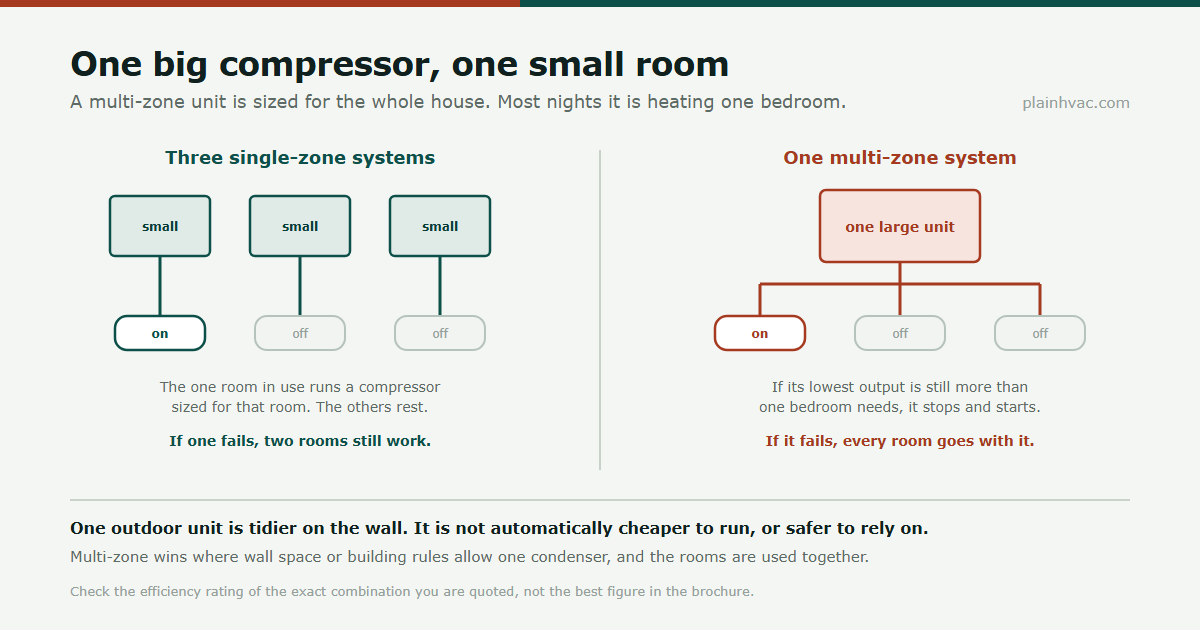
An inverter compressor slows down to match the load, but only so far. Every outdoor unit has a lowest speed it can hold steadily. Installers size a multi-zone unit for all its rooms together. So its floor sits higher than that of a small single-zone unit. On a mild night with one bedroom calling for heat, that floor can still be more than the room needs.
When the lowest output exceeds the load, the system has only one option. It stops, waits, and starts again. Short cycles waste efficiency and add wear, and the room swings around its setting instead of holding it. The same pattern on any heat pump, and the free checks that come first: heat pump short cycling.
Single-zone units avoid this by design. Each one matches its own room. The one in use runs close to its comfortable range while the others rest.
One machine means one point of failure
With three single-zone systems, a failed compressor or circuit board takes out one room. With a multi-zone system, the same fault takes out every room on it at once. If the mini split is your only heat, that difference matters more than any efficiency figure. In a cold climate, also compare what each design delivers at 5 °F (−15 °C): how a mini split holds up in deep cold.
Check the rating of the exact combination
A multi-zone outdoor unit does not have one efficiency rating. Its rating depends on which indoor units hang off it. Mitsubishi says many combinations in that range have earned ENERGY STAR certification, which also means some have not. NEEP’s cold-climate specification goes further. It lets manufacturers describe multi-zone systems by type of indoor unit: ducted, non-ducted or mixed. That is not the same as the exact heads on your quote.
So ask the installer for the rating of the exact outdoor unit and heads on the quote. The best figure for the range is not yours. The ENERGY STAR product finder and the NEEP list both let you look systems up by brand and model.
Line sets, drains and standby power add up differently
- Line sets. Every head on a multi-zone system runs its own line set back to the one outdoor unit. The maker limits each run as well as the total. A head in a far corner can break a limit that a separate unit next to it would not: how long a line set can be.
- Drains. Each indoor head needs its own condensate route with a steady fall, whatever happens outside: where to mount the indoor head.
- Standby power. Three outdoor units mean three sets of electronics waiting, and in cold weather possibly three crankcase heaters. The cost varies by model, and published figures disagree: what a mini split draws doing nothing.
Single zone vs multi zone mini split: when each wins
Multi-zone makes sense when the building allows only one outdoor unit, as in many condos and townhouses. It also helps when outside wall space is scarce. And it suits rooms that run together, so the compressor rarely works for one small room alone.
Single-zone systems make sense when you use rooms at different times, or when one room is much smaller than the rest. They also make sense when you want a fault in one room to stay in that room, or when you plan to add rooms over several years. And they let you pick a different size, or even a different brand, for each space. If price pushes you toward a cheaper brand, the trade-offs are the same in both layouts: are budget brands worth it.
What this page does not settle
Sizing each room needs a proper room-by-room load calculation, not a rule of thumb. This page cannot tell you whether your smallest room falls below a particular unit’s minimum output. The manufacturer’s data and a load calculation together can, so ask the installer to show you both before you sign.
Live with either layout? Tell us in the comments how it behaves on a mild night with one room in use. Real experience at low loads is the part no brochure covers.