
Yes, a mini-split keeps heating in real cold, and a good one keeps doing it efficiently well below freezing. The useful question about mini split cold weather performance is not whether it runs, but how much heat it still delivers when you need the most. Brochures answer the first question. You need the second, and it sits in a table most buyers never see.
The number on the brochure is a limit, not an output
“Heats down to −13 °F” describes the coldest temperature at which the unit is designed to keep operating. It says nothing about how much heat comes out at that temperature. A heat pump moves heat from the outdoor air into the house, and the colder that air gets, the less heat there is to move and the harder the compressor works to move it.
So capacity falls as the temperature falls, and it falls fastest on exactly the nights your house loses heat fastest. A unit that comfortably heats a room at 40 °F (4 °C) can be short of what that room needs at 5 °F (−15 °C) while still being, technically, “working”.
What happened in a real house at −25 °C
The most useful evidence comes from a Natural Resources Canada field study at the Canadian Centre for Housing Technology in Ottawa, which ran cold-climate mini-splits in an instrumented test house through a real winter.
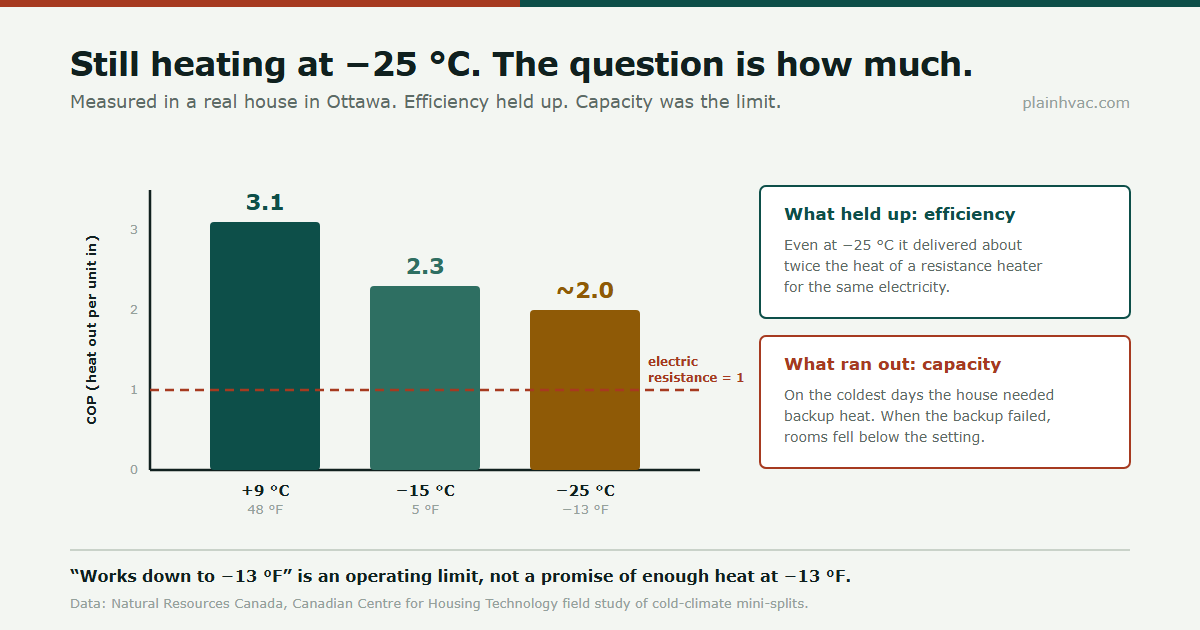
The efficiency held up remarkably well. The researchers measured a coefficient of performance of about 3.1 at +9 °C (48 °F), about 2.3 at −15 °C (5 °F), and close to 2.0 at −25 °C (−13 °F). Even at the bottom of that range, every unit of electricity bought about two units of heat, twice what a resistance heater would deliver.
What ran out was capacity. The mini-splits kept the house comfortable below −15 °C, but with some backup heat on the coldest days. And the study recorded what happens without it: the backup was a gas fireplace, and when it failed to come on during the coldest spells, the rooms dropped well below their setting. That is the honest shape of cold-weather performance. The heat pump keeps working efficiently; it simply stops being enough on its own.
Mini split cold weather capacity: what your model actually delivers
Skip the brochure and look up the exact outdoor and indoor model pair on the NEEP cold-climate heat pump list. For each listed system it reports capacity and efficiency at 47 °F, 17 °F and 5 °F. Three things to read off it:
- Capacity at 5 °F against capacity at 47 °F. The closer those two numbers are, the better the unit holds its output in deep cold. This ratio matters more than the headline size.
- COP at 5 °F. NEEP’s cold-climate specification requires at least 1.75 at maximum capacity to qualify. At that level you still get well over one and a half times the heat a resistance heater would give for the same electricity.
- Capacity at 5 °F against what the room actually loses. If the room needs more heat on a design-cold night than the unit can make at that temperature, no efficiency figure rescues it.
One trap specific to small systems: a 120 V unit starts with modest capacity, so the drop in deep cold leaves it very little margin. If you are weighing one, read the cold-weather column first: what 120 V solves and what it does not.
Defrost takes a bite out of the coldest hours
In cold, damp weather frost builds on the outdoor coil, and the unit periodically reverses to clear it. During each defrost it delivers no heat to the room, and on some systems it briefly delivers cool air instead. The NEEP figures are steady-state numbers, and the specification tells manufacturers to leave defrost out of them. That is one more reason the real output on a raw, foggy −5 °C morning can feel worse than on a dry, clear −15 °C one. What normal defrost looks like, and when ice is a fault rather than a cycle: ice on the outdoor unit.
Plan the backup before the cold night, not during it
The Canadian house needed backup heat, and its problems came from the backup failing rather than from the heat pump. That points at the decision worth making in autumn rather than January:
- Electric resistance strips in a ducted heat pump. Simple, but expensive to run, and how often they come on depends on settings most installers leave at default: why auxiliary heat runs so much.
- An existing gas furnace kept as backup in a dual fuel system, where the switchover point is a price decision rather than a temperature one: the switchover temperature.
- A separate heater in the one or two rooms a ductless system cannot reach on the coldest nights.
And do not undermine the system with your own schedule. Deep overnight setbacks force a big morning recovery at the coldest hour of the day, precisely when capacity is lowest: why turning it down at night can cost more.
What a homeowner can do, and what to leave alone
Keep the outdoor unit clear of snow drifts and of anything that blocks its airflow, leave clearance underneath for meltwater, and resist chipping ice off the coil, which bends the fins and can puncture the tubing. Raising the unit on a stand where snow lies deep is worth asking about at installation rather than after the first storm.
Diagnosing why a system will not keep up, checking refrigerant, or changing defrost settings belongs to a technician. If the unit runs constantly in cold weather and the rooms still fall behind, write down the outdoor temperature when it happens; that single observation tells a technician more than any description. And if the air simply feels cool at the vents while the room is warming, that is usually normal: when cool air is normal and when it is not.
Field data from one Canadian house is not your house, and cold-climate equipment improves every year. If you install these in a colder place than Ottawa and see figures that disagree with the ones above, post them in the comments with the model and the temperature. Real numbers from real winters are the most useful thing anyone can add here.