
Bad thermostat placement makes a healthy system behave like a broken one. Your whole house takes its orders from one sensor on one wall, so if that spot runs warmer or cooler than the rooms you actually live in, every cycle starts and stops at the wrong moment. It costs nothing to check what yours is standing next to, and it explains a surprising share of complaints that get blamed on equipment.
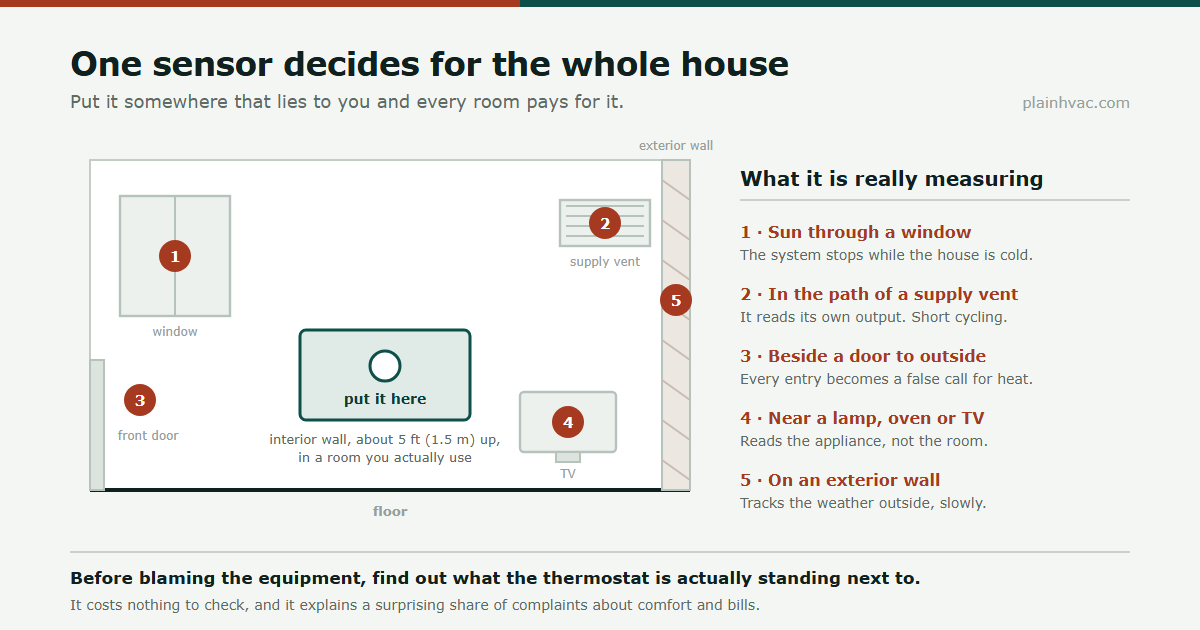
The five spots that lie to the system
- Where the sun reaches it. A patch of afternoon sun can lift a thermostat several degrees above the room. In summer the cooling runs long after the house is cold; in winter the heating stops early. The giveaway is a complaint that moves with the time of day.
- In the path of a supply vent. The thermostat reads its own output rather than the room, satisfies almost immediately, shuts down, and starts again once the air settles. That is one of the classic manufactured causes of short cycling.
- Beside an exterior door. Every entry and exit hands the sensor a gust of outdoor air, and each one becomes a false call for heating or cooling. Common in hallways, which is exactly where builders like to put thermostats.
- Near a lamp, television, oven or return grille. Anything that makes heat or moves air changes what the sensor sees. A television below a thermostat runs it warm every evening.
- On an exterior wall. The wall itself tracks the weather outside, slowly and invisibly. The sensor ends up splitting the difference between your room and the street.
Correct thermostat placement, and why
An interior wall, roughly 5 ft (1.5 m) above the floor, in a room the household actually uses. Away from vents, doors, windows, appliances and direct sun. Somewhere with ordinary air movement, so the sensor sees the room rather than a still pocket of it.
That last point matters more than it sounds. A thermostat in a dead corner or behind a door reads a microclimate, and dead air lags behind the rest of the room by a surprising margin.
Which room do you want to be right?
There is an uncomfortable fact underneath all of this: one sensor cannot represent a house. A two-storey building is warmer upstairs than downstairs in summer and, in a draughty house, often the reverse in winter, because warm air rises and cold air falls whatever your equipment does about it. Put the sensor upstairs and the ground floor runs cold; put it downstairs and the bedrooms overheat. Neither position is wrong. They are different choices about who is comfortable.
So it is worth deciding deliberately rather than inheriting the builder’s decision. The usual logic: put the sensor where the household spends its waking hours, accept that the other floor will be imperfect, and deal with the difference by other means — balancing dampers, a schedule that anticipates the pattern, or genuine zoning if the gap is large and permanent. Zoning is the real answer to a house that needs two different temperatures at once, and it carries its own well-known trap.
A second point follows from this and is often missed. If you relocate the sensor or add a remote one, you are not fixing the house; you are changing which room the system is honest about. That can be exactly the right move, and it is cheap. It is just worth knowing what you are buying.
Compare the readings before changing anything
- Put a cheap thermometer in the room where comfort actually matters to you, at about the same height.
- Compare readings with the thermostat several times a day, especially at the times the problem shows up.
- Watch for a pattern. A gap that appears every afternoon points at sun. A gap that only appears while the system runs points at a vent. A steady offset in cold weather points at an exterior wall.
- Test the sun theory directly by taping a piece of card to shade the thermostat for a day and seeing whether behaviour changes.
A persistent difference is a reason to investigate, not proof that the thermostat is at fault. Thermometer accuracy, uneven airflow and other equipment problems can also affect the readings. Look for a repeatable pattern before deciding to relocate the sensor.
What to do once you know
- Remove the influence if you can. A lamp moves. A curtain fixes the sun. Redirecting a vent away from the wall sometimes solves it outright.
- Use a remote sensor. Some thermostats support compatible remote sensors. Depending on the model and settings, these can let the system use a bedroom or living-room reading. Check the manufacturer’s compatibility list and control options before buying.
- Move the thermostat. Real work: running new low-voltage wire and patching the old wall. Worth it when nothing else applies, but treat it as the last option rather than the first.
One thing worth knowing before you spend anything: a remote sensor solves a sensing problem, not a distribution problem. If one room is genuinely starved of air, no amount of sensor relocation fixes it: four tests for not enough return air, and what a booster fan can and cannot move.
Where thermostat placement costs money, not just comfort
On a heat pump the consequences run deeper than comfort. A sensor reading several degrees low keeps calling for heat the house does not need, and on many systems a large enough gap brings in the electric backup, which costs several times what the compressor does: why auxiliary heat runs so much.
Whether that matters financially depends on your rate, so check what you pay per kilowatt hour before deciding how hard to chase it. And if the sensor is fine but the heat never arrives where you want it, the loss may be happening in transit: ENERGY STAR puts typical duct losses at 20 to 30 per cent of the air moving through the system: which ducts you can seal yourself.
The settings that matter as much as the spot
Placement decides what the sensor sees. A handful of settings decide what the system does about it, and they are free to change.
- The fan setting. AUTO runs the blower only when heating or cooling; ON runs it continuously. People switch to ON to even out temperatures between rooms, and it does help with that. In cooling season it has a cost that is rarely mentioned: once the compressor stops, the indoor coil is still wet, and continuing to blow air across it evaporates that water straight back into the house. A home that is cool but clammy, with the fan set to ON, has usually found its own explanation. See cold is not the same as dry.
- Cycle rate, swing or differential. Most thermostats let you set how far the temperature may drift before the system responds, and some let you cap cycles per hour. A wide setting means long runs and noticeable swings; a narrow one means tighter control and more starts. If your complaint is frequent cycling, this setting is worth looking at before anything is diagnosed as a fault.
- Smart or adaptive recovery. A thermostat that starts early to reach the setpoint by the scheduled time is usually doing you a favour. On a heat pump it can be an expensive one, because the quickest way to recover a large setback is the electric backup. Where the thermostat offers a separate setting for how far it may lean on auxiliary heat, that is the one to look at before blaming the equipment: why auxiliary heat runs so much.
- Setback depth, on a heat pump. Deep night setbacks make sense with a furnace, which recovers cheaply. They often do not with a heat pump, for the same reason: the recovery is paid for at resistance-heat prices. Shallower setbacks, or none, frequently cost less.
- Heating and cooling mode, in shoulder seasons. A thermostat left in AUTO changeover with a narrow deadband can heat in the morning and cool in the afternoon on the same day, which feels like the system fighting itself because it is.
Write down what any setting was before you change it, change one thing at a time, and give each change a few days in comparable weather. A setting changed and forgotten is indistinguishable from a fault six months later.
Scope and safety
What this article covers: judging whether your thermostat sits somewhere that misreads the house, and the low-cost ways round it.
What it does not cover: running new thermostat wiring, adding a C wire, or working inside the air handler where the low-voltage transformer lives.
Stop and call someone if you would need to open the air handler or fish wire through a wall you cannot see into. Thermostat wiring is low voltage and relatively forgiving, but it originates at a transformer inside equipment that also carries line voltage.
Before relocating the thermostat
Keep a short record of thermostat and room readings, the time of day, and whether heating or cooling was running. Bring that record and the thermostat model number to an installer before paying for relocation. Check remote-sensor compatibility in the model documentation; a temperature difference alone does not establish the cause.